RICS Valuation Report Example: What a Red Book Report Must Contain
·9 min read
In short
A RICS valuation report, or Red Book report, is a written valuation prepared in accordance with RICS Valuation – Global Standards. Its content is governed by VPS 6, which sets no layout but lists what every report must address: the valuer, the client and intended users, the purpose, the asset, the basis of value, the valuation date, the extent of investigation, the information relied upon, the assumptions, the approach and reasoning, significant ESG factors, the amount, any material uncertainty, the restrictions on use, the standards followed, any limitation of liability and the date of the report.
Search for a "RICS valuation report template" and you will find plenty of documents to download. Most valuers who search for one are not short of a layout, though. They want to know what a Red Book report must contain, in what order, and how to tell whether their own report would survive a review.
This guide answers that. It sets out the minimum content the RICS Red Book requires of a valuation report, walks through a Red Book valuation report example section by section, and lists six mistakes that make a report fail. A template helps with the first of those three. The other two depend on the work behind the report.
What is a RICS valuation report?
A RICS valuation report, often called a Red Book report, is a written valuation prepared in accordance with RICS Valuation – Global Standards. The current edition took effect on 31 January 2025. Reports are governed by VPS 6 (Valuation reports), which was numbered VPS 3 in earlier editions. If your template still cites VPS 3 for reporting, it predates the current standards.
VPS 6 does not prescribe a layout. It sets a list of matters that every report must address, and it requires the report to communicate the valuation clearly and without ambiguity. Two firms can therefore produce reports that look quite different and are both compliant, provided each one covers the required content. If the numbering of the standards is new to you, start with our guide to RICS Red Book compliance, which covers all six VPS.
Why a RICS valuation report template is not enough
RICS publishes its own valuation report framework for the 2025 edition. Its guidance on use is candid about what a framework can and cannot do. The frameworks are aimed at sole practitioners and small firms, they are meant to help with the mandatory minimum content, and in the guidance's own words they "do not tell the valuer what to say".
That is the limit of any template. A heading called "Extent of investigation" is easy to add. What goes under it has to describe what was agreed with the client, what was done, and what was found on this assignment. A report can carry every required heading and still fail, because the text under the headings is generic, contradicts the terms of engagement or leaves out the reasoning.
The minimum content of a Red Book valuation report
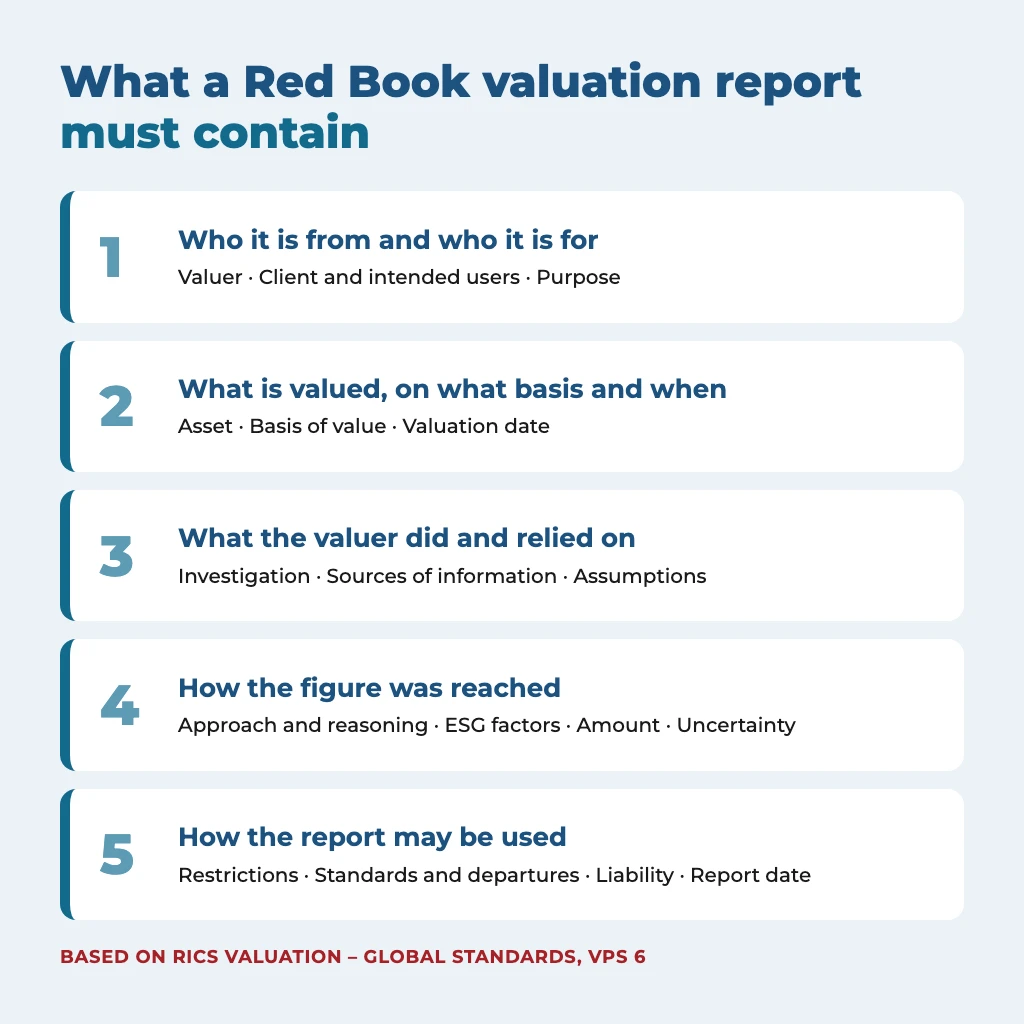
The headings below follow the RICS valuation report framework for the 2025 edition, which is based directly on the list of mandatory content in VPS 6 paragraph 2.1. They are grouped here by the question each one answers.
Who the report is from and who it is for
Identification and status of the responsible valuer. Name and qualifications, registered valuer status, experience, internal or external status where applicable, any previous involvement with the property or the parties, and a declaration of independence, objectivity and competence.
Identification of the client and any other intended users. Any other party entitled to rely on the report must be identified.
Purpose of the valuation. The precise end use: secured lending, financial reporting, taxation and so on. Each purpose brings its own regulatory requirements.
What is valued, on what basis and when
Identification of the asset or liability valued. The address, the interest valued, any tenancies, and the facts about the property: location, description, accommodation and areas.
Basis of value adopted. Stated with its definition. Our guide to the bases of value explains each one and when it applies.
Valuation date. A specific date. Good practice is to state three dates, even where two coincide: the date of inspection, the valuation date and the date of the report.
What the valuer did and relied on
Extent of investigation. What was inspected and investigated, the limitations that were agreed, any part of the property that could not be accessed, and what the valuer found.
Nature and sources of the information relied upon, including the sources of key data and inputs, and how far they were checked.
Assumptions and special assumptions. Each one stated in full, with any reservations.
How the figure was reached
Valuation approach and reasoning, including the methods and any complex or proprietary models used, the key inputs and the principal reasons for the conclusion. The framework notes one exception: where it has been specifically agreed and recorded in the terms of engagement that the report will be provided without reasons or supporting information.
Significant environmental, social and governance (ESG) factors and their effect on the valuation. This is not an ESG rating or risk assessment. We cover the detail in ESG in property valuation.
Amount of the valuation, in figures and in words, in the applicable currency.
Commentary on any material valuation uncertainty. This is mandatory only where the uncertainty is material.
How the report may be used
Restrictions on use, distribution and publication of the report.
Confirmation that the valuation was undertaken in accordance with IVS and/or the Red Book, naming the edition, with details of any departure agreed with the client.
Limitations on liability that have been agreed with the client.
Date of the valuation report, which may differ from the valuation date.
The required content answers five questions. A reviewer looks for each of them.
A Red Book valuation report example, section by section
A list of headings only goes so far. The example below shows one way to organise a complete report so that each required matter has its place. It is the structure of the valuation report InterVal generates, in two sections.
Section 1: the valuation report
The report opens with a valuation summary: a letter to the client, with a signature block, that states the instruction, the type of inspection, the interest valued, the valuation date and the figure, in numbers and in words. A one-page table follows, with the adopted value, the client, the purpose and the approach used. A reader who goes no further already has the answer and the conditions attached to it.
The scope of work comes next and carries the formal content of the report, each matter under its own numbered heading: the identification and status of the valuer, the purpose of the valuation, the property identification, the basis of value, the valuation and investigation dates, the nature and extent of the valuer's work with its limitations, the nature and sources of information, assumptions, special assumptions, departures, restrictions on use, the valuation standards applied, the valuation approach and reasoning, material valuation uncertainty, limitations on liability and the conflict of interest check.
The target property summary then describes the location and the property itself. The valuation section presents the comparables, the adjustments and the calculation.
Section 2: the appendices
The appendices hold the supporting material: the certifications of the firm and of the lead valuer, the full conflict of interest disclosure, additional documents on the property, the condition ratings recorded at inspection, the measurements, the detail of each comparable and the market research. Keeping this material in appendices leaves the body of the report short enough to read, while the evidence stays attached to the report it supports.
Two points are worth copying whatever software you use. The summary comes first, so the client reads the conclusion before the detail. And each matter has its own heading, so a reviewer can find it without reading the whole report.
The summary comes first: the figure, the date and the conditions attached to it.
The report should mirror the terms of engagement
The list of required content for a report closely follows the list for terms of engagement in VPS 1. The two lists belong together. The terms of engagement record what was agreed before the work started, and the report states what was done on that basis. RICS's guidance puts it simply: the report should mirror the terms of engagement.
In practice, the purpose, the basis of value, the extent of investigation, the assumptions and the restrictions on use should read the same in both documents. In the report they are written in the past tense and completed with what the valuer found. Where an assumption agreed at the outset no longer holds after the inspection, the report must say so and state the assumption that replaces it.
This is where copied templates do the most damage. Terms of engagement written in one document and a report written in another drift apart: an assumption is reworded, a limitation is dropped, the purpose changes slightly. Each difference is an ambiguity that a reviewer, or the other side's adviser, will find.
Six mistakes that make a report fail
Outdated references. The report cites VPS 3 for reporting, or an earlier edition of the standards, because the template was never updated.
Dates left unstated. The inspection date, the valuation date and the report date are not each stated.
Assumptions the client never agreed. An assumption or special assumption in the report that is absent from the terms of engagement, with no explanation of when it was introduced.
An approach without reasoning. The report names the approach and gives the figure, but not the method, the key inputs or the reasons for the conclusion.
Boilerplate on uncertainty and ESG. A standard paragraph is pasted into every report, whether or not it applies to the property.
No named intended users. The report does not say who else may rely on it, or what restrictions apply to its use and publication.
A better valuer would not avoid any of these. A better process would, which is why they repeat from one report to the next until the process changes.
When the valuation is referred to in a published document
Some valuations are quoted outside the report, for example in financial statements or a prospectus. Where the purpose of the report requires a published reference to it, a draft statement is typically required for inclusion in that publication, so the reference is accurate and does not mislead.
A checklist before you sign
The report names the current edition of the standards and cites VPS 6, not VPS 3.
The valuer, the client and every other intended user are identified.
The purpose, the basis of value and its definition are stated.
The inspection date, the valuation date and the report date are all given.
The extent of investigation states what was agreed, what was done and what was found.
Sources of information and key inputs are listed, with the extent to which they were checked.
Every assumption and special assumption matches the terms of engagement, or the change is explained.
The approach, the method, any model used and the reasoning are set out.
Significant ESG factors and any material valuation uncertainty are addressed for this property.
The figure is given in numbers and words, in the stated currency.
Restrictions on use, any departures and any agreed limitation of liability are stated.
From template to generated report
A template gives you the headings once. It does not keep the report consistent with the terms of engagement, and it does not record how the report was produced. Those two things are what a reviewer checks.
InterVal approaches the report from the other end. The terms of engagement, the conflict of interest check, the inspection, the comparable evidence and the calculation are recorded in one project as the work is done. The valuation report and the draft statement are then generated from that record, from consistent templates, so the report draws on what was recorded at the start and not on a retyped copy. An audit trail records the interactions with the client and logs the main steps up to the delivery of the report.
You can see how the workflow follows the standards on the RICS Red Book compliance software page, or contact us to see a report generated on your own use case. The valuer keeps the judgement and the professional responsibility. The software takes care of the structure and the record.
This guide is provided for general information and reflects the standards in force at the date of publication. It is not a substitute for the standards themselves: always refer to the current edition of RICS Valuation – Global Standards and to RICS guidance applicable in your jurisdiction.
Frequently asked questions
What must a RICS Red Book valuation report contain?
Under VPS 6 it must identify the valuer, the client and any other intended users, and state the purpose, the asset valued, the basis of value, the valuation date, the extent of investigation, the information relied upon, the assumptions and special assumptions, the approach and reasoning, significant ESG factors, the amount of the valuation, any material valuation uncertainty, the restrictions on use, confirmation of the standards followed, any agreed limitation of liability and the date of the report.
Is there an official RICS valuation report template?
RICS publishes a valuation report framework for the 2025 edition of the Red Book. It is aimed at sole practitioners and small firms, its headings follow the mandatory content of VPS 6, and its guidance says the frameworks do not tell the valuer what to say. The Red Book itself prescribes the content of a report, not its layout.
Which Red Book standard covers valuation reports?
VPS 6 (Valuation reports) in the edition of RICS Valuation – Global Standards effective from 31 January 2025. It was numbered VPS 3 in earlier editions, so a template that still cites VPS 3 for reporting predates the current standards.
How is a RICS valuation report example structured?
One structure that works has two sections. The report itself opens with a valuation summary, then a scope of work that gives each required matter its own numbered heading, then the property summary and the valuation with its comparables and calculation. The appendices hold the certifications, disclosures, condition ratings, measurements, comparable details and market research.
Why should a valuation report match the terms of engagement?
Because the terms of engagement record what was agreed and the report states what was done on that basis. The purpose, the basis of value, the extent of investigation, the assumptions and the restrictions on use should read the same in both, and any assumption that changed after the inspection must be explained in the report.
There is no single rulebook for property valuation in the UAE. What applies nationally, what we could verify for each of the seven emirates, and five checks before you accept an instruction.
Market value, investment value and fair value sound interchangeable and sometimes give the same figure. They are three different questions, and one of them comes from accounting standards, not valuation standards. What each one measures, when to use it, one building valued three ways, and the neighbouring terms that add to the confusion.
Subscribe to our Newsletter
Subscribe to our newsletter to receive exclusive offers, latest news and updates.
Less than one hour to obtain a fully standard Compliant Valuation.