ESG in Property Valuation: What the Mandatory RICS Standard Means for Valuers
EFEmile Frémont, MRICS — Lead Valuer, InterVal··6 min read
In short
ESG in property valuation means assessing, on the evidence, how environmental, social and governance factors — energy performance, climate risk, occupier wellbeing, data quality — affect a property's value at the valuation date. Since 30 April 2026 the RICS ESG standard (4th edition) is mandatory for RICS members and firms, and ESG is embedded in both the Red Book 2025 and IVS 2025.
For years, ESG in property valuation sat in an awkward place: clearly important, increasingly priced by the market, but treated by many valuers as someone else's job — the sustainability consultant's, the asset manager's, anyone's but the person signing the valuation report.
That position is no longer tenable. As of 30 April 2026, RICS's dedicated global standard on ESG and sustainability in commercial property valuation (now in its 4th edition) is mandatory for RICS members and firms, and it sits alongside the Red Book 2025 and IVS 2025 — both of which already weave ESG into the core valuation process. ESG is now part of doing the job properly, not an optional extra.
This guide explains what ESG actually means inside a valuation, where it now lives in the standards, the one distinction that trips people up, and what it changes in day-to-day practice.
What "ESG" means in a valuation context
ESG is a broad label, so it helps to ground each letter in things a valuer can actually observe and evidence on a property.
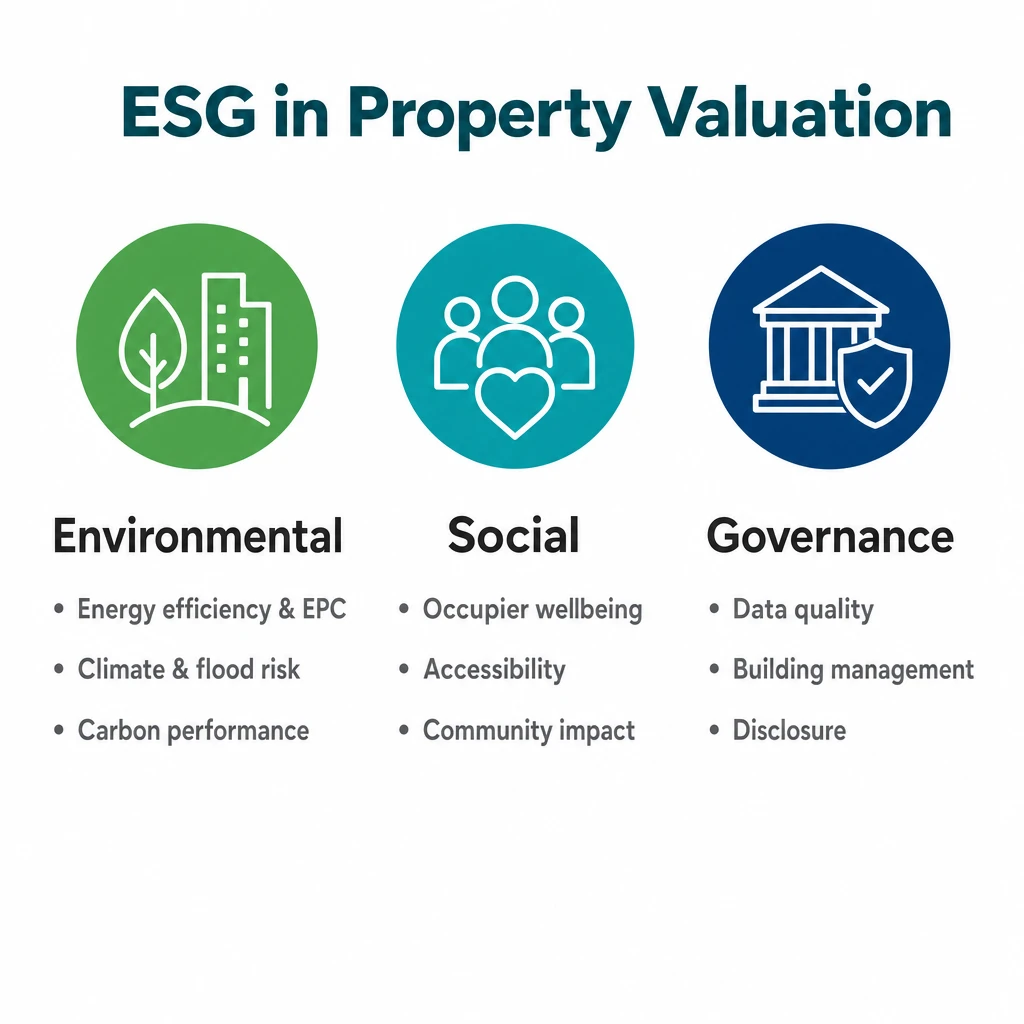
Environmental. Energy efficiency and ratings (such as EPCs in the UK/EU), carbon performance, climate-related physical risks (flooding, overheating, subsidence), embodied carbon, water use, and resilience to transition risk — the risk that a building becomes harder to let or sell as regulation and demand shift toward greener stock.
Social. Occupier health, wellbeing and amenity, accessibility, safety, and the building's relationship with its community and local economy.
Governance. The quality and transparency of the data behind the asset: how the building is managed, the reliability of its sustainability information, and compliance with relevant disclosure frameworks.
The valuer's job is not to grade a building's morality. It is to assess, on the evidence, whether and how these factors affect value — because increasingly they do.
Where ESG now sits in the standards
ESG is no longer a footnote bolted onto valuation guidance. It is embedded across the framework valuers already follow:
The RICS ESG standard, 4th edition — "Sustainability and ESG in commercial property valuation and strategic advice" — became mandatory on 30 April 2026. It aligns with the Red Book and IVS, adds jurisdiction-specific sections for the UK, EU and Australia (reflecting their different regulatory regimes), and includes a consolidated global list of typical ESG-related KPIs so valuers have a common vocabulary.
IVS 2025 embeds ESG in IVS 104 (Data and Inputs), which carries a dedicated appendix on ESG considerations — signalling that ESG is treated as part of the data and inputs every valuation rests on, not a separate exercise.
The Red Book 2025 requires the basis of value, assumptions and the extent of investigation to be appropriate and clearly stated — and where ESG is a significant value factor, that includes how it was considered. (If you want the full structure, see our practitioner guide to RICS Red Book compliance.)
The distinction that trips people up: valuation vs. strategic ESG advice
This is the single most important clarification in the 4th edition, and it is worth stating plainly because getting it wrong creates real liability.
Reflecting ESG in a valuation means assessing how the market prices ESG factors today, on the evidence available at the valuation date. If energy-inefficient buildings in a market are transacting at a discount, the valuation should reflect that discount — not because the valuer disapproves of inefficient buildings, but because the market does.
Strategic ESG advice — recommending a retrofit programme, modelling a path to net zero, advising on how to improve an asset's rating — is a separate, additional service. The 4th edition confirms it should not be confused with, or folded into, the valuation. A valuation tells you what an asset is worth now given how the market treats its ESG profile; strategic advice tells you what to do about it. Mixing the two muddies the report and exposes the valuer.
How ESG actually moves value
The market mechanism behind all of this is straightforward, even if the data is still maturing. Two related effects are now widely recognised:
The "green premium" — better-performing, well-certified buildings attracting stronger rents, lower yields, and deeper occupier and investor demand.
The "brown discount" — and its sharper cousin, stranding risk, where assets that fall behind on energy performance or regulation become progressively harder to let, finance or sell, and may need significant capital expenditure simply to remain marketable.
In jurisdictions with minimum energy efficiency regulation (the UK's MEES regime is the obvious example), an inadequate rating can directly restrict the ability to let a property — a value consequence that is concrete, not speculative. The specifics differ by market, which is exactly why the 4th edition added jurisdiction-specific sections.
ESG in a valuation, grounded: what each pillar means in evidence a valuer can assess.
What it changes in day-to-day practice
For the working valuer, the mandatory standard turns into a few concrete habits:
Capture ESG data consistently. EPC or equivalent ratings, certifications, climate-risk exposure and the other KPIs the standard sets out should be gathered as a routine part of every commercial assignment — not improvised when a client happens to ask.
Reflect it where it is a significant value factor. Not every ESG attribute moves the number, and the standard does not ask you to pretend it does. The judgement is whether, on the market evidence, a given factor is material to value — and to say so.
Record your reasoning. As with every part of the Red Book, ESG is evidenced, not asserted. The file should show what ESG information was considered, what weight it was given, and why — so the report stands up to a reviewer who reads it two years later.
Keep valuation and advice separate. If the client wants a retrofit strategy, scope it as a distinct engagement.
Where software fits
The honest difficulty with ESG is consistency. ESG data is scattered, the KPIs are numerous, and capturing them reliably across every assignment by hand — in a spreadsheet, in notes, in memory — is exactly where things slip. (We wrote about that structural problem in valuation software vs. spreadsheets.)
This is the case for handling ESG inside the valuation workflow rather than alongside it. InterVal includes a built-in ESG module that lets valuers capture sustainability-related risks and attributes directly within the assignment, as a structured part of the process — so the data is recorded consistently, carried into the report, and preserved in the audit trail rather than reconstructed afterwards. ESG stops being a separate worksheet and becomes part of the file.
Sustainability is now part of what makes a building lettable, financeable and valuable — and so part of the valuation.
The bottom line
ESG in valuation has crossed the line from "good practice" to "the standard." With the RICS ESG standard mandatory since 30 April 2026, and ESG embedded in both the Red Book and IVS 2025, the question for valuers is no longer whether to consider sustainability factors, but how to do it consistently, evidence it properly, and keep it cleanly separated from strategic advice. The valuers who build ESG into their workflow now — rather than scrambling when a client or regulator asks — will simply be doing the job the standards already require.
This guide is provided for general information and reflects the standards in force at the date of publication. ESG regulation is jurisdiction-specific and evolving fast; always refer to the current edition of the RICS standard on ESG and sustainability in commercial property valuation, RICS Valuation – Global Standards, IVS, and the rules applicable in your market.
Frequently asked questions
Is ESG mandatory in property valuation?
Yes. RICS's dedicated global standard on ESG and sustainability in commercial property valuation (4th edition) became mandatory on 30 April 2026, and ESG is now embedded in both the Red Book 2025 and IVS 2025. Considering ESG factors is part of doing the job properly, not an optional extra.
What is the difference between reflecting ESG in a valuation and giving strategic ESG advice?
Reflecting ESG in a valuation means assessing how the market prices ESG factors today, on the evidence at the valuation date — if inefficient buildings transact at a discount, the valuation reflects that discount. Strategic ESG advice — recommending a retrofit programme or modelling a path to net zero — is a separate, additional service. The 4th edition is explicit that the two should not be confused, because mixing them exposes the valuer.
What are the green premium and the brown discount?
The green premium is better-performing, well-certified buildings attracting stronger rents, lower yields and deeper demand. The brown discount — and its sharper cousin, stranding risk — is where assets that fall behind on energy performance or regulation become progressively harder to let, finance or sell, and may need significant capital expenditure to stay marketable.
How should valuers capture ESG data?
Consistently, as a routine part of every commercial assignment rather than improvised when a client asks: EPC or equivalent ratings, certifications, climate-risk exposure and the other KPIs the standard sets out. Reflect ESG where it is a material value factor, record what was considered and why, and keep valuation and strategic advice separate.
Where does ESG sit in IVS 2025?
IVS 2025 embeds ESG in IVS 104 (Data and Inputs), which carries a dedicated appendix on ESG considerations — signalling that ESG is treated as part of the data and inputs every valuation rests on, not a separate exercise.
An audit trail sounds like bureaucracy; it is the opposite — the record of how a valuation was reached, and the only thing that lets a reviewer, insurer or regulator rely on it years later. What a defensible audit trail contains, where the RICS Red Book and IVS require it, why files fail without one, and why it should be captured as you work rather than reconstructed from memory.
Valuation files are some of the most sensitive data a professional handles — so is the cloud safe for them? A practical framework from InterVal's technology lead: what real cloud security looks like (encryption, access control, audited hosting, data residency, backups, audit trail, data ownership), the questions to ask any vendor, and why the real risk is usually the laptop-and-email workflow, not the cloud.
Subscribe to our Newsletter
Subscribe to our newsletter to receive exclusive offers, latest news and updates.
Less than one hour to obtain a fully standard Compliant Valuation.