What Is RICS Red Book Compliance? A Practical Guide for Property Valuers
EFEmile Frémont, MRICS — Lead Valuer, InterVal··7 min read
In short
The RICS Red Book — formally RICS Valuation – Global Standards — is the mandatory professional framework that RICS members and RICS-regulated firms must follow when producing valuations. It does not tell you what a property is worth; it sets out how a competent, ethical and well-documented valuation must be conducted and reported, and it incorporates the International Valuation Standards (IVS).
If you produce property valuations professionally, "Red Book compliant" is probably the single most important phrase in your working vocabulary. Clients ask for it, lenders demand it, and RICS regulation is built around it. Yet ask three valuers what Red Book compliance actually requires in practice, and you may get three different answers — especially since the standards were restructured in 2025.
This guide explains what the RICS Red Book is, who must comply with it, how the current edition is organised, and what compliance looks like at each stage of a valuation assignment.
What is the RICS Red Book?
The "Red Book" is the informal name for RICS Valuation – Global Standards, published by the Royal Institution of Chartered Surveyors (RICS). It sets the professional and technical framework that RICS members and RICS-regulated firms must follow when providing valuation services.
The Red Book does not tell you what a property is worth — it tells you how a competent, ethical, and well-documented valuation must be conducted and reported. Its purpose is consistency, transparency and public trust: two valuers following the Red Book should produce reports a client, lender, auditor or court can rely on in the same way.
Crucially, the Red Book incorporates the International Valuation Standards (IVS) published by the IVSC. Complying with the Red Book therefore means complying with IVS as well — which is why the two are usually mentioned in the same breath.
Which edition applies now?
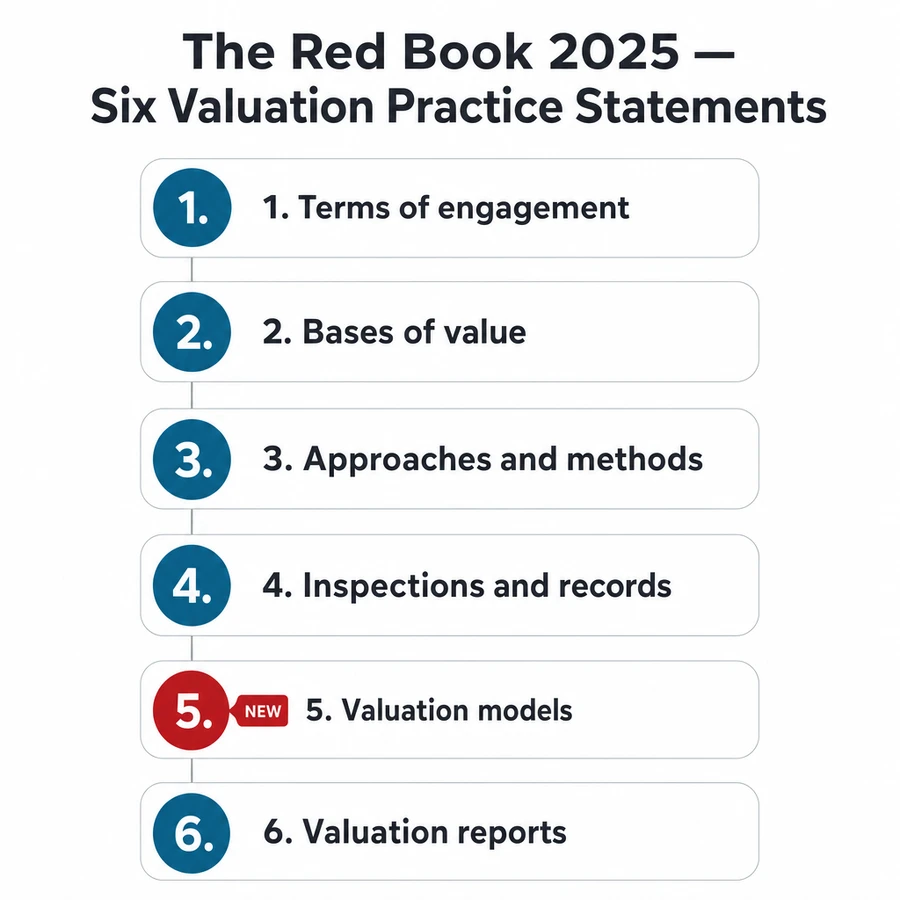
The current edition, published in December 2024, took effect on 31 January 2025, the same day as the updated IVS. It was a significant revision: the number of mandatory Valuation Practice Statements (VPS) increased from five to six, and several were renumbered. If your templates, checklists or precedent reports still cite the old numbering, they are out of date.
Old vs. new VPS numbering at a glance
VPS 1 — Terms of engagement. Unchanged in scope: the written basis of every assignment.
VPS 2 — Bases of value, assumptions and special assumptions. Previously VPS 4; now also covers the treatment of transaction costs.
VPS 3 — Valuation approaches and methods. Previously part of VPS 5; now explicitly covers methods as well as approaches.
VPS 4 — Inspections, investigations and records. Previously VPS 2.
VPS 5 — Valuation models. New in 2025, responding to the growing role of models and technology in valuation practice.
VPS 6 — Valuation reports. Previously VPS 3.
Beyond the renumbering, the 2025 edition strengthened expectations around technology, data, valuation models and ESG factors — areas where regulators expect valuation practice to keep evolving. (ESG in particular has its own now-mandatory RICS standard; we cover what that means in ESG in property valuation.)
The six mandatory VPS of the 2025 edition — VPS 5 (valuation models) is the newcomer.
Who must comply?
Red Book compliance is mandatory for RICS members (AssocRICS, MRICS, FRICS) and RICS-regulated firms providing written valuations, with limited exceptions defined in the standards themselves (for example certain internal or agency contexts). Registered Valuers are subject to RICS's Valuer Registration quality-assurance scheme, under which their work can be monitored against the Red Book.
In practice, compliance is also a commercial requirement: banks, funds, auditors and courts routinely insist on Red Book valuations even where the valuer's membership status would not strictly require it.
What compliance means at each stage of an assignment
1. Before you accept the instruction
Compliance starts before any valuation work. You must confirm that you are competent for the asset type and market, that you are independent, and that no conflict of interest exists — or that an identified conflict has been disclosed and properly managed with the client's informed consent. A documented conflict-of-interest check is the foundation of a defensible file.
2. Terms of engagement (VPS 1)
Every assignment needs written terms of engagement agreed before the valuation is reported, covering — among other items — the identity of the valuer and client, the asset, the purpose of the valuation, the basis of value, assumptions and special assumptions, restrictions on use, and the basis of fees. If the scope changes mid-assignment, the terms must be amended in writing.
3. Bases of value (VPS 2)
The basis of value — Market Value, Market Rent, Fair Value, Investment Value, and so on — must be appropriate to the purpose, explicitly stated, and properly defined. Assumptions and special assumptions must be agreed in advance and clearly recorded, not discovered by the client in the final report. (If the distinction between these bases isn't second nature yet, our guide to the bases of value explains each one and when to use it.)
4. Approach and method (VPS 3)
The valuer must select and justify the valuation approach — market, income or cost — and the method within it. The choice must suit the asset, the available data and the purpose of the valuation, and the reasoning must be capable of standing up to scrutiny. (For one income-approach method in depth, see our guide to discounted cash flow in property valuation.)
5. Inspection, investigation and records (VPS 4)
Inspections and investigations must be appropriate to the assignment, any limitations (such as a desktop or external-only inspection) must be agreed and disclosed, and — critically — a proper record must be kept. The file, not the valuer's memory, is what demonstrates compliance years later.
6. Valuation models (VPS 5)
New since 2025: where models are used, the valuer remains responsible for understanding them, for the integrity of inputs and outputs, and for documenting the model's role in the valuation. "The spreadsheet said so" has never been a defence; now the standards say so explicitly.
7. The report (VPS 6)
The report must communicate the valuation clearly and unambiguously, and must address the minimum required content — from the identification of the valuer and the basis of value through to the valuation date, the extent of investigation, and the valuation itself. Where the valuation will be referenced in a published document, a draft statement is typically required.
8. After delivery: the audit trail
Red Book compliance is evidenced, not asserted. A complete audit trail — engagement documents, consents, inspection records, comparable evidence, calculations, drafts and the final report — is what turns "we complied" into something a reviewer, insurer or regulator can verify.
Where valuation files most often fail
InterVal exists because our founding team saw non-compliance at scale. During an IMF-commissioned Asset Quality Review, our founder's firm — then the only RICS-accredited valuation practice in Mongolia — had to assess thousands of valuation reports used as collateral by local banks. The overwhelming majority failed to follow RICS, IVS or any other standard. The same failure patterns appear, in smaller doses, in mature markets too:
No written terms of engagement, or terms agreed after the work was done;
Bases of value left undefined, or assumptions appearing for the first time in the report;
No record of the inspection's extent or its agreed limitations;
Comparable evidence and adjustments that cannot be reconstructed from the file;
Reports that omit minimum required content — often because the template predates the current standards;
No audit trail connecting the engagement, the evidence and the final figure.
None of these failures is usually about valuation judgement. They are process failures — and process is exactly what can be systematised.
Compliance is evidenced, not asserted: the file is what a reviewer sees years later.
A practical compliance checklist
✓ Competence, independence and conflict check documented before acceptance
✓ Written terms of engagement agreed before reporting (VPS 1)
✓ Basis of value defined; assumptions and special assumptions agreed and recorded (VPS 2)
✓ Approach and method selected and justified (VPS 3)
✓ Inspection extent and limitations agreed, performed and recorded (VPS 4)
✓ Report contains all minimum required content; draft statement where required (VPS 6)
✓ Complete audit trail retained for the file
How software changes the compliance equation
Most valuers still assemble compliance manually: a Word template here, a spreadsheet there, evidence in email threads, and a hope that nothing was missed. It works — until a file is challenged.
A structured valuation platform approaches the problem differently: the workflow itself enforces the standards. In InterVal, each stage of the Red Book process is a step in a guided decision tree — conflict-of-interest checks and informed consent, terms of engagement, inspection and investigation records, method selection, draft statements and the final report, with an audit trail generated as you work rather than reconstructed afterwards. You can see what the output looks like in our sample reports, mapped to the documents the Red Book actually expects, or read how practitioners use it day-to-day.
Whether you systematise with software or with rigorous internal procedure, the principle is the same: compliance should be a property of your process, not a heroic effort at the end of each assignment.
This guide is provided for general information and reflects the standards in force at the date of publication. It is not a substitute for the standards themselves — always refer to the current edition of RICS Valuation – Global Standards and to RICS guidance applicable in your jurisdiction.
Frequently asked questions
Is the Red Book the same as IVS?
No, but they are designed to work together. IVS are the international technical standards published by the IVSC; the Red Book incorporates IVS and adds RICS's professional, ethical and procedural requirements. A Red Book valuation is IVS-compliant by construction.
Who must comply with the RICS Red Book?
Red Book compliance is mandatory for RICS members (AssocRICS, MRICS, FRICS) and RICS-regulated firms providing written valuations, with limited exceptions defined in the standards. In practice it is also a commercial requirement: banks, funds, auditors and courts routinely insist on Red Book valuations regardless of membership status.
What are the six VPS of the Red Book?
VPS 1 (terms of engagement), VPS 2 (bases of value, assumptions and special assumptions), VPS 3 (valuation approaches and methods), VPS 4 (inspections, investigations and records), VPS 5 (valuation models — new in 2025), and VPS 6 (valuation reports).
Does Red Book compliance apply outside the UK?
Yes. RICS Valuation – Global Standards apply to RICS members and regulated firms worldwide, with jurisdiction-specific supplements (such as the UK National Supplement) adding local requirements where relevant.
What changed in the 2025 Red Book edition?
The current edition took effect on 31 January 2025, alongside the updated IVS. The headline changes: six mandatory VPS instead of five, a renumbered structure, a new standard dedicated to valuation models (VPS 5), and strengthened expectations around technology, data and ESG.
An audit trail sounds like bureaucracy; it is the opposite — the record of how a valuation was reached, and the only thing that lets a reviewer, insurer or regulator rely on it years later. What a defensible audit trail contains, where the RICS Red Book and IVS require it, why files fail without one, and why it should be captured as you work rather than reconstructed from memory.
Valuation files are some of the most sensitive data a professional handles — so is the cloud safe for them? A practical framework from InterVal's technology lead: what real cloud security looks like (encryption, access control, audited hosting, data residency, backups, audit trail, data ownership), the questions to ask any vendor, and why the real risk is usually the laptop-and-email workflow, not the cloud.
Subscribe to our Newsletter
Subscribe to our newsletter to receive exclusive offers, latest news and updates.
Less than one hour to obtain a fully standard Compliant Valuation.