Market Value vs Investment Value vs Fair Value: How to Tell Them Apart
·10 min read
In short
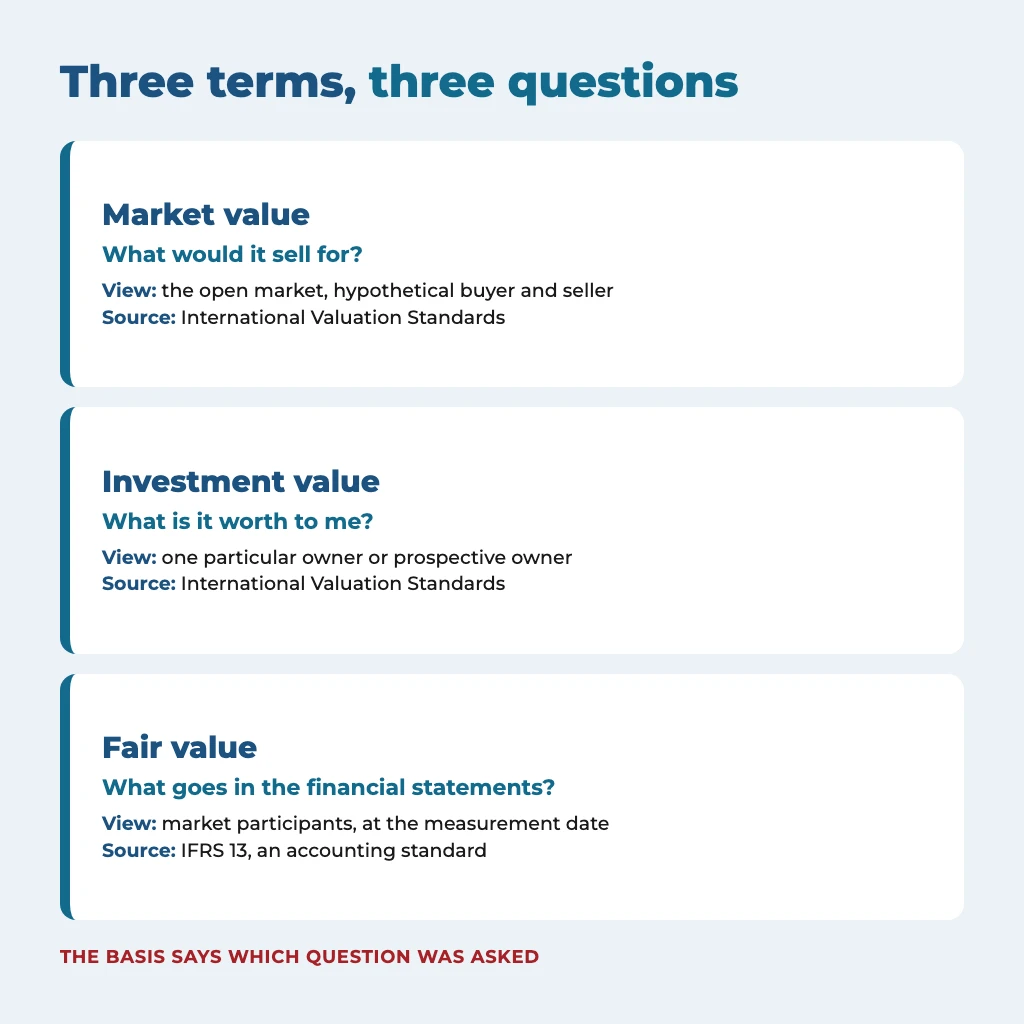
Market value is the price an asset would fetch on the open market, between a hypothetical willing buyer and willing seller. Investment value is what the asset is worth to one particular owner or prospective owner, given that party's own objectives. Fair value, in financial reporting, is defined in IFRS 13 as the price that would be received to sell an asset in an orderly transaction between market participants at the measurement date. The first two are bases of value defined in the International Valuation Standards; the third comes from accounting standards.
Market value, investment value and fair value are three terms clients often mix up. They sound interchangeable, and on some assignments they even produce the same figure. They are still three different questions, they do not all come from the same standards, and a report that answers the wrong one is of no use to the person who commissioned it.
This guide compares the three side by side: what each one measures, who defines it, when it applies, and how the same building can carry three figures on the same day. It also sorts out the neighbouring terms that add to the confusion, from equitable value to value in use. For the full list of bases defined in the International Valuation Standards, see our reference guide to the bases of value.
Market value vs investment value vs fair value: the short answer
Market value is the price the open market would pay. It assumes a hypothetical willing buyer and willing seller, and it does not depend on who the client is.
Investment value is what the asset is worth to one particular owner or prospective owner, given that party's own objectives.
Fair value is an accounting measurement. Under IFRS 13 it is the price that would be received to sell an asset in an orderly transaction between market participants at the measurement date.
Market value and investment value are bases of value defined in the International Valuation Standards (IVS 102 in the edition effective from 31 January 2025). Fair value, in the sense most clients mean, comes from accounting standards. That difference of origin explains most of the confusion.
Market value: the market's view
IVS defines market value as the estimated amount for which an asset should exchange on the valuation date between a willing buyer and a willing seller in an arm's-length transaction, after proper marketing, where the parties each acted knowledgeably, prudently and without compulsion.
The parties in that definition are hypothetical. The valuer does not ask what the client would pay or accept. The valuer asks what a typical, informed participant in that market would agree to on that date, and supports the answer with market evidence. Two valuers working for two different clients should therefore arrive at figures close to each other.
Market value is the usual basis for secured lending, for sales and purchases, and for most valuations where a third party will rely on the figure. It is the answer to "what would it sell for?"
Investment value vs market value: one party's view
IVS defines investment value, also called worth, as the value of an asset to a particular owner or prospective owner for individual investment or operational objectives.
Here the client is part of the question. The figure reflects that party's own position: the return it requires, its cost of capital, its tax position, the use it intends to make of the property, or the benefit of combining the asset with others it already holds. No sale is assumed. Investment value is the answer to "what is it worth to me?"
Three consequences follow, and each one is worth stating to the client.
It is specific to one party. The same asset can have a different investment value for each party that looks at it.
It is not a price. It says the most the party could justify paying, or the least it should accept. It does not say what the market will pay.
It relies on the client's own inputs. The report should say which assumptions came from the client and which the valuer tested.
Investment value is often estimated with a cash flow model built on the client's own assumptions. Our guide to discounted cash flow in property valuation covers that method.
Fair value vs market value: the accounting view
Fair value is defined in IFRS 13 as the price that would be received to sell an asset or paid to transfer a liability in an orderly transaction between market participants at the measurement date. It is an exit price, measured from the point of view of market participants and not of the entity that holds the asset.
For most real property, fair value under IFRS is broadly consistent with market value. Both look at the market and both ignore the particular owner. They are still not the same thing. Fair value is governed by the accounting standards: they decide when it must be measured, how the measurement is disclosed, and how the inputs are classified. A valuer who reports fair value for financial statements works to the requirements of those standards as well as to the valuation standards, and should agree with the client and its auditor which ones apply.
The other "fair value"
There is a second source of confusion. Older editions of IVS used "fair value" for a different basis: the price for a transfer between two identified parties that reflects the respective interests of those parties. IVS renamed that basis equitable value to end the clash with the accounting term. Statutes, shareholder agreements and courts also use "fair value" with meanings of their own, which vary from one jurisdiction to another.
When a client asks for "fair value", ask which one: fair value for financial reporting, a fair price between two named parties, or a term defined in a contract or a statute. Each of the three leads to a different definition, and sometimes to a different figure.
Market value and investment value share a source and differ in whose view they take. Fair value comes from an accounting standard.
One building, three figures: an illustration
Take an office building that produces a net income of 600,000 a year. The figures below are invented for the illustration and simplified to one step of arithmetic.
Market value. Recent sales of comparable buildings show buyers paying prices that reflect a yield of 6%. Capitalising 600,000 at 6% gives 10,000,000.
Investment value. A long-term investor is considering the purchase. With a lower cost of capital and a longer holding period than the typical buyer, it would accept a yield of 5.5% on this kind of asset. Capitalising the same income at 5.5% gives about 10,900,000. That is the most this investor could justify paying. It is not evidence that the market would pay it.
Fair value. The current owner reports under IFRS and needs a figure for its financial statements. The measurement takes the view of market participants, uses the same market evidence, and in this simple case arrives at 10,000,000.
The gap of about 900,000 between market value and investment value is not an error in either figure. It is information. It tells the investor how much room it has in a negotiation, and it tells the seller why this buyer may bid above the others. A report that gave only one of the two figures would hide it.
Which basis for which purpose
Secured lending. Usually market value. The lender needs to know what the security would fetch, whoever the borrower is. Some jurisdictions or lenders require another basis, such as mortgage lending value.
Purchase or sale. Market value, with investment value alongside it where the client wants to know its own limit.
Financial statements under IFRS. Fair value as defined in IFRS 13, where the accounting standards call for it.
Hold-or-sell decisions and portfolio strategy. Investment value, compared with market value.
A transfer between two identified parties. Often equitable value, for example between related companies or shareholders, unless a contract, a statute or a tax rule requires another basis.
The purpose comes first and the basis follows from it. Under the RICS Red Book, the basis of value must be appropriate to the purpose, stated explicitly and defined, in the terms of engagement and again in the report (VPS 2, with VPS 1 for the terms of engagement and VPS 6 for the report). Our guide to RICS Red Book compliance sets out where that requirement sits among the others.
Related terms that cause confusion
Equitable value
The price for a transfer between two specific, identified parties, reflecting the interests of each. It differs from market value because the parties are real and named, and from investment value because it weighs two positions and not one.
Synergistic value, or marriage value
The additional value created when two or more assets or interests are combined and the whole is worth more than the sum of the parts. Two adjoining plots that together allow a larger development are the usual example.
Forced sale value
A forced sale describes the circumstances of a disposal, not a basis of value. The figure is market value or liquidation value assessed under a stated assumption about the constraint on the seller and the time available to sell. It is a special assumption where that constraint does not actually exist at the valuation date.
Value in use vs market value
An accounting term from IAS 36, the standard on impairment of assets: the present value of the future cash flows expected to be derived from an asset or cash-generating unit. Market value looks at what the market would pay; value in use looks at what the asset will earn for the entity that holds it. Like investment value it is specific to the entity, but it is defined by the accounting standards. Together with fair value less costs of disposal, it is used to test whether an asset is impaired.
Book value
The amount at which an asset is carried in the accounts. It is the result of accounting entries and may bear no relation to what the market would pay. It is not a basis of value.
Open market value
An older term that still appears in leases and legacy documents. Current valuation standards use market value. Where a document refers to open market value, check how that document defines it before assuming the two are the same.
On the same day, one building can carry a market value, an investment value and a fair value.
Five mistakes to avoid
Reporting "fair value" without saying which one. Name the standard or the document that defines it.
Presenting investment value as a price. A figure built on one party's own return requirements says nothing about what the market will pay.
Using the client's own assumptions in a market value. Market value rests on market evidence. The client's cost of capital, tax position or plans belong in investment value.
Treating a forced sale as a basis. State the basis, then state the assumption or special assumption about the sale.
Leaving the basis to be inferred. A figure with no stated basis and no definition can be read three ways, and each reader will pick the one that suits them.
How to state the basis in a report
Three things should appear in both the terms of engagement and the report, worded consistently.
The basis by name, for example market value.
Its definition and the source of that definition: the International Valuation Standards for market value and investment value, IFRS 13 for fair value in financial statements, or the contract or statute that sets a term of its own.
Any assumption or special assumption attached to it, such as vacant possession or a restricted marketing period.
Where a report gives two bases, for example market value and investment value, present them separately, each with its definition and its inputs, so that neither figure can be mistaken for the other. Our guide to what a RICS valuation report must contain shows where the basis sits among the other required content.
Keeping the basis consistent from engagement to report
Many problems with bases of value are not errors of judgement. The basis was right at the outset and then changed along the way: one wording in the terms of engagement, another in the summary, a third in the conclusion.
InterVal records the basis of value once, as a structured field at the start of the assignment, and every document generated afterwards takes it from there. The valuer still chooses the basis and remains responsible for the choice. The software carries the same basis from the terms of engagement through to the report. To see it on your own use cases, book a 45-minute demo, or contact us.
This guide is provided for general information and reflects the standards in force at the date of publication. Definitions are summarised; always refer to the current edition of the International Valuation Standards, RICS Valuation – Global Standards and the applicable accounting standards for the authoritative wording, and to guidance applicable in your jurisdiction.
Frequently asked questions
Can investment value be higher than market value?
Yes. Market value is the price the open market would pay, whoever the client is. Investment value is what the asset is worth to one particular owner or prospective owner, given that party's own position. An office building with a net income of 600,000 a year is worth 10,000,000 at a market yield of 6%, and about 10,900,000 to an investor with a lower cost of capital who would accept a yield of 5.5%. That higher figure is the most the investor could justify paying, not what the market would pay.
Is fair value the same as market value under IFRS 13?
Not exactly. Fair value under IFRS 13 is an accounting measurement: the price that would be received to sell an asset in an orderly transaction between market participants at the measurement date. Market value is a basis of value defined in the International Valuation Standards. For most real property the two are broadly consistent, but fair value is governed by the accounting standards, which decide when it is measured and how it is disclosed.
What is investment value in property valuation?
Investment value, also called worth, is defined in the International Valuation Standards as the value of an asset to a particular owner or prospective owner for individual investment or operational objectives. It is specific to one party, it assumes no sale, and it relies on that party's own inputs.
What is forced sale value in property valuation?
Forced sale value is not a basis of value in its own right. A forced sale describes the circumstances of a disposal: the figure is market value or liquidation value assessed under a stated assumption about the constraint on the seller and the time available to sell. It is a special assumption where that constraint does not actually exist at the valuation date.
What does equitable value mean?
Equitable value is a basis of value defined in the International Valuation Standards: the price for a transfer between two specific, identified parties that reflects the respective interests of those parties. Older editions of IVS called it fair value; it was renamed to end the confusion with the fair value of IFRS 13, which takes the view of market participants.
A template gives you the headings of a valuation report, not its content. What the RICS Red Book requires a report to contain under VPS 6, an example structure walked through section by section, and six mistakes that make a report fail.
What the RICS Red Book requires in practice: the 2025 edition's six VPS explained stage by stage, the most common compliance failures, and a practical checklist for defensible valuation files.
Subscribe to our Newsletter
Subscribe to our newsletter to receive exclusive offers, latest news and updates.
Less than one hour to obtain a fully standard Compliant Valuation.