The Audit Trail in Property Valuation: Why Compliance Is Evidenced, Not Asserted
EFEmile Frémont, MRICS — Lead Valuer, InterVal··7 min read
In short
A valuation audit trail is the complete, dated record of how a valuation was reached — the terms of engagement, conflict check, inspection, comparable evidence, assumptions, reasoning, drafts and final report — captured as the work happens. It is what turns a valuation from an assertion into something a reviewer, insurer or regulator can independently verify years later: under the RICS Red Book and IVS, compliance is evidenced, not asserted.
Of all the phrases in a valuer's working vocabulary, "audit trail" is the one most likely to be heard as bureaucracy — a box to tick after the real work is done, a folder to assemble if anyone ever asks. That reading is exactly backwards. In valuation, the audit trail is not the paperwork around the deliverable. It is the deliverable's insurance policy.
A valuation is, in the end, an opinion. A defensible valuation is an opinion someone can rely on — and reliance is not built on the figure alone. It is built on being able to show, later, how that figure was reached. That is the whole function of the audit trail, and it rests on a single principle that governs everything below: compliance is evidenced, not asserted.
What an audit trail actually is
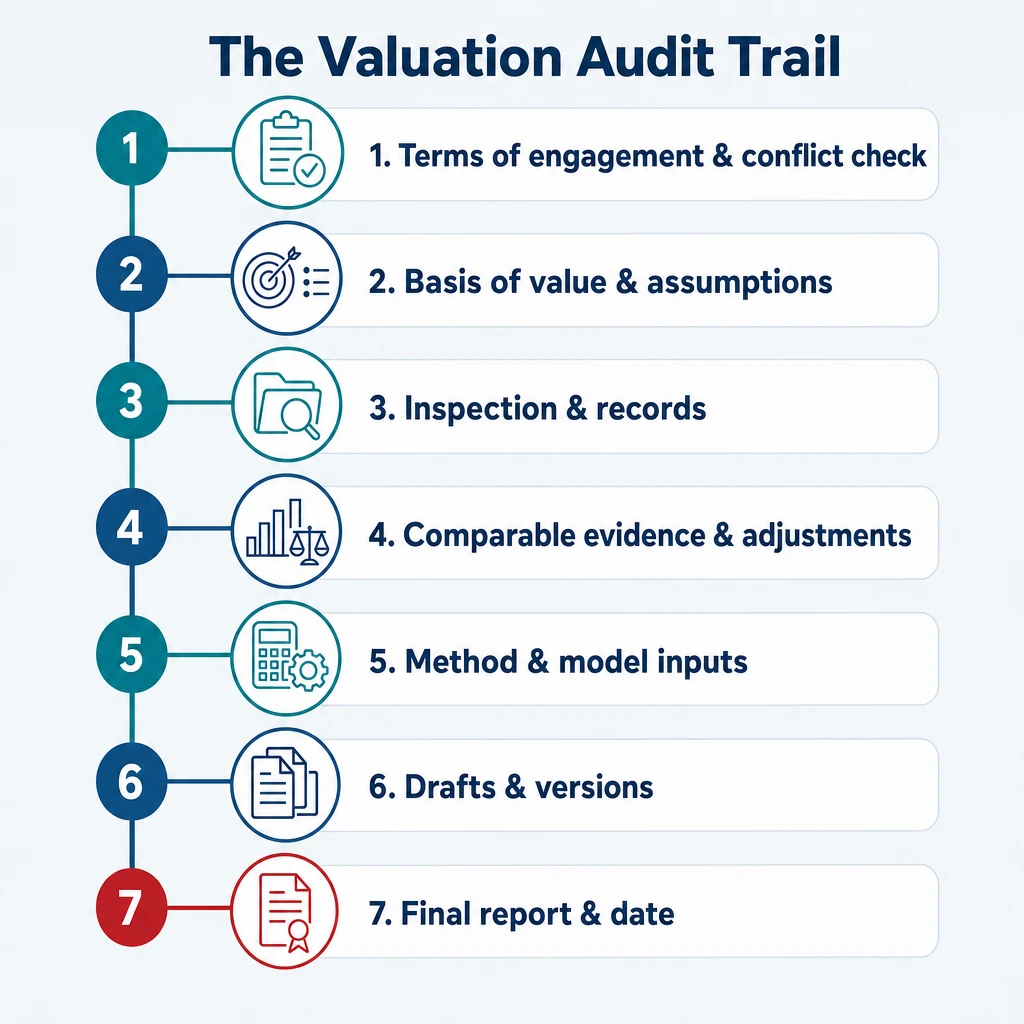
The audit trail is not the final number, and it is not the report. It is the complete, dated record of how you got to the number: the terms of engagement, the conflict check and the client's consent, the inspection and its limits, the comparable evidence and the adjustments you made to it, the assumptions you agreed, the reasoning behind the method you chose, the drafts, and the final report — together with the order in which those things happened.
Put simply: if the valuation answers "what is it worth?", the audit trail answers "how do you know, and can you show it?" A valuation without that second answer is not wrong, exactly. It is undefended.
Why it matters: the file is what survives you
Most valuations are delivered and then forgotten — by everyone except the file. Months or years later, something happens. A loan secured on the property defaults and the lender's recovery team pulls the valuation apart. A transaction is challenged. An insurer investigates a claim. A court needs to understand how a number was reached. Or your work is sampled by RICS under the Valuer Registration quality-assurance scheme, which exists precisely to monitor members' valuations against the standards.
At that moment — and it is always later, and always by someone who was not there — "trust me, I did it properly" is not a defence. The file is the defence. A complete audit trail is what turns "we complied" into something a reviewer, an insurer or a regulator can independently verify. Everyone who reads your work after the fact is really reading the trail. (This is the same discipline the RICS Red Book is built around; our practitioner guide to Red Book compliance walks through it stage by stage.)
Where the audit trail sits in the standards
None of this is optional good practice bolted on by cautious firms. The requirement to record your work is woven through the RICS Red Book (RICS Valuation – Global Standards) and the International Valuation Standards it incorporates.
VPS 1 — terms of engagement must be agreed in writing before the valuation is reported, and any change of scope amended in writing.
VPS 4 — inspections, investigations and records is explicit: a proper record must be kept. The file, not the valuer's memory, is what demonstrates compliance years later.
VPS 5 — valuation models, new in the 2025 edition, holds the valuer responsible for the integrity of the models they use and for documenting the model's role. "The spreadsheet said so" has never been a defence; since 2025 the standards say so in writing.
VPS 6 — valuation reports sets the minimum content the report itself must communicate.
The direction of travel across the 2025 revision, aligned with IVS, is unmistakable: more of the valuer's reasoning has to be capable of being shown, not merely stated. (The models point matters most where the arithmetic is sensitive — see our guide to discounted cash flow, where an undocumented assumption can move the answer a long way.)
What a defensible audit trail contains
A defensible audit trail is a spine that runs the length of the assignment — captured as you work, not assembled at the end.
A file that can stand up to scrutiny holds all of the following, each with a date and each capable of being reconstructed by someone who was not in the room:
Engagement and scope. The written terms of engagement, agreed before reporting, plus the documented competence, independence and conflict-of-interest check that preceded acceptance.
Basis of value and assumptions. The basis explicitly stated and appropriate to the purpose; assumptions and special assumptions agreed in advance and recorded — not discovered by the client in the final report. (If the choice of basis is not yet second nature, our guide to the bases of value sets each one out.)
Inspection and investigation. The extent of what was done, any agreed limitations (a desktop or external-only inspection, say), the date, and what was actually observed.
Evidence. The comparable evidence and the adjustments made to it, recorded so that a reviewer can follow the path from the market data to your figure — rather than having to take the leap on faith.
Method and reasoning. The approach and method selected and justified, and where a model is used, the inputs and where they came from.
Drafts and versions. What changed between drafts, and when.
The report and its date. The final report, the valuation date, and any draft statement required where the valuation will be referenced publicly.
Where audit trails fail
InterVal's founding team saw the consequences of a missing audit trail at a scale most valuers never will. During an Asset Quality Review commissioned by the International Monetary Fund, the firm — then the only RICS-accredited valuation practice in Mongolia — had to assess thousands of valuation reports held as collateral by the country's banks. The overwhelming majority could not be relied upon, and the reason was rarely a bad opinion of value. It was that nothing in the file recorded how the opinion had been reached. The work could not be reconstructed, so it could not be defended.
The same failure patterns appear, in smaller doses, in mature markets every day:
terms of engagement agreed after the work was done, or not at all;
assumptions that appear for the first time in the report, never agreed with the client;
no record of the inspection's extent or its agreed limitations;
comparable evidence and adjustments that cannot be reconstructed from the file;
an audit trail assembled in a hurry, from memory, only once a file is challenged.
That last one is the quiet killer, because it looks like diligence. A trail reconstructed after the fact is not evidence; it is a story told later, and a reviewer can tell the difference. The standards expect records kept at the time, precisely because contemporaneous records are the only ones that carry weight.
Years later, a reviewer reads the file — not the valuer's memory of the assignment.
Built as you work, not bolted on at the end
Here is the honest difficulty. Done manually, the audit trail depends on discipline — the same discipline, applied without fail, on every assignment, with no safety net for the day you are rushing to a deadline. The familiar Word-and-Excel workflow makes it worse, because a spreadsheet records the final number, not the reasoning, the evidence or the sequence. It will let a perfectly compliant-looking report leave the building with nothing behind it. (We set that failure mode out in valuation software vs. spreadsheets.)
The way out is not more heroics at the end of each job. It is to have the trail write itself as you go. In InterVal, the assignment moves through a guided sequence — conflict check and informed consent, terms of engagement, inspection and investigation records, method selection, drafts and the final report — and each step is recorded as you complete it. The audit trail is generated by the process rather than reconstructed afterwards, which means the file is complete by the time the report is, not weeks later when someone asks. You can see what that produces in our sample reports, each mapped to the documents the Red Book expects.
The bottom line
A valuation is an opinion; the audit trail is what makes that opinion defensible. It is not bureaucracy and it is not an afterthought — it is the difference between work you can stand behind years later and work you can only describe from memory. Whether you build it with software or with rigorous internal procedure, the principle does not change: capture the reasoning as the work happens, because the file, not your recollection, is what a reviewer, an insurer or a regulator will read. Compliance is evidenced, not asserted — and the audit trail is the evidence.
This guide is provided for general information and reflects the standards in force at the date of publication. It is not a substitute for the standards themselves — always refer to the current edition of RICS Valuation – Global Standards, to the International Valuation Standards, and to RICS guidance applicable in your jurisdiction.
Frequently asked questions
What is a valuation audit trail?
It is the dated record of how a valuation was reached — not the final figure, but the terms of engagement, conflict check, inspection, comparable evidence and adjustments, assumptions, method and reasoning, drafts and final report, in the order they happened. If the valuation answers "what is it worth?", the audit trail answers "how do you know, and can you show it?"
Why does a valuation need an audit trail?
Because compliance is evidenced, not asserted. A valuation is delivered and forgotten by everyone except the file. When it is later challenged — a defaulted loan, a disputed transaction, an insurer's claim, a court, or RICS Valuer Registration monitoring — "trust me, I did it properly" is not a defence. A complete audit trail is what turns "we complied" into something a reviewer, insurer or regulator can independently verify.
What should a valuation audit trail contain?
Written terms of engagement agreed before reporting, plus the competence and conflict-of-interest check; the basis of value and the assumptions agreed in advance; the inspection's extent, limitations and date; the comparable evidence and adjustments, reconstructable by someone who was not there; the method and reasoning, with model inputs and their sources; the drafts and what changed between them; and the final report with its valuation date.
Where do the RICS Red Book and IVS require an audit trail?
It runs through the Red Book: VPS 1 (written terms of engagement), VPS 4 (inspections, investigations and records), VPS 5 (valuation models — new in 2025, making the valuer responsible for documenting the models used), and VPS 6 (report content), alongside IVS 2025. The 2025 edition strengthened the expectation that a valuer's reasoning can be shown, not merely stated.
Can an audit trail be reconstructed after the valuation?
A trail assembled from memory once a file is challenged is weak evidence at best — a reviewer can tell the difference between a contemporaneous record and a story told later. The standards expect records kept at the time. The reliable approach is to capture the trail as the work happens, so the file is complete by the time the report is.
Valuation files are some of the most sensitive data a professional handles — so is the cloud safe for them? A practical framework from InterVal's technology lead: what real cloud security looks like (encryption, access control, audited hosting, data residency, backups, audit trail, data ownership), the questions to ask any vendor, and why the real risk is usually the laptop-and-email workflow, not the cloud.
A practitioner's honest guide to choosing property valuation software: the eight criteria that actually matter — compliance built in, end-to-end workflow, methods, audit trail, collaboration — the red flags to avoid, and the cases where software isn't the answer at all.
Subscribe to our Newsletter
Subscribe to our newsletter to receive exclusive offers, latest news and updates.
Less than one hour to obtain a fully standard Compliant Valuation.