Equitable Value, Synergistic Value and Forced Sale Value Explained
·11 min read
In short
Equitable value is the estimated price for the transfer of an asset or liability between identified knowledgeable and willing parties that reflects the respective interests of those parties. Synergistic value, or marriage value, arises when two or more assets or interests are combined and the whole is worth more than the sum of the parts. Both are bases of value defined in the International Valuation Standards. Forced sale value is not a basis of value: a forced sale describes the circumstances of a sale, and the figure is market value or liquidation value assessed under a stated assumption about the constraint on the seller.
Most valuations are reported on market value. Some instructions ask for something else: a price that is fair between two named parties, the extra value released when two interests are combined, or the figure a property would fetch if it had to be sold quickly. These three requests go by the names equitable value, synergistic value and forced sale value.
The first two are bases of value defined in the International Valuation Standards. The third is not a basis at all, although clients and lenders ask for it by name. This guide explains what each one means, how it differs from market value, and how to report it. For the full list of bases, see our reference guide to the bases of value, and for the three terms clients confuse most often, our comparison of market value, investment value and fair value.
Equitable value, synergistic value and forced sale value: the short answer
Equitable value is the price for a transfer between two identified parties that reflects the interests of each. It answers "what is fair between these two?"
Synergistic value, also called marriage value, is the value created when two or more assets or interests are combined and the whole is worth more than the sum of the parts.
Forced sale value is market value or liquidation value assessed under a stated assumption about a seller who is under pressure and short of time. A forced sale describes a situation. It is not a basis of value.
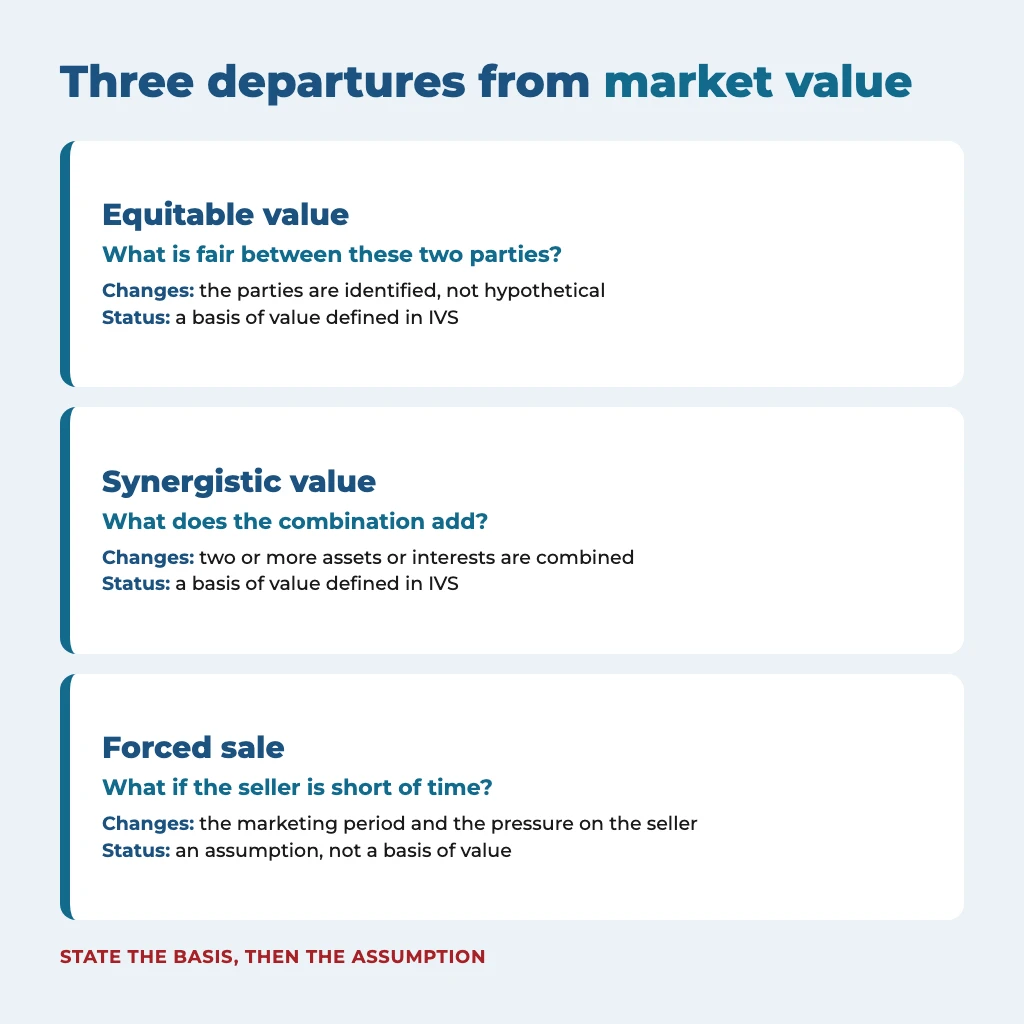
All three depart from the central idea of market value, which is a sale between hypothetical parties, after proper marketing, with nobody under compulsion. Equitable value replaces the hypothetical parties with real ones. Synergistic value brings in a benefit that only a combination can produce. A forced sale removes the proper marketing and adds the compulsion.
Equitable value: a fair price between two named parties
The International Valuation Standards (IVS 102 in the edition effective from 31 January 2025) define equitable value as the estimated price for the transfer of an asset or liability between identified knowledgeable and willing parties that reflects the respective interests of those parties.
The word that matters is "identified". Market value ignores who the parties are. It asks what a typical buyer and a typical seller would agree, and it disregards any advantage or disadvantage that would not be available to market participants in general. Equitable value does the opposite: it looks at two specific parties and weighs what each one gains or gives up through the transfer.
How it differs from market value and investment value
Equitable value is a broader concept than market value. In many cases the price that is fair between two parties is simply the price the market would pay. It differs when the two parties stand in a particular relationship to the asset, so that the transfer is worth more, or less, to them than to anyone else.
It also differs from investment value. Investment value takes the view of one party and says what the asset is worth to that party alone. Equitable value takes two views and looks for a price that is fair to both. Investment value is often an input: a valuer may work out what the transfer is worth to each side before forming a view on the price between them.
When equitable value is used
Landlord and tenant. The price for a tenant to surrender its lease, or for a landlord to buy it out, depends on what each one gains. The market at large is not a party to the deal.
Shareholders and partners. A buy-out of one owner by another, where the holdings of the two parties make the interest worth something different between them than it would be to an outside buyer.
Transfers within a group. A transfer between related companies, unless a contract, a statute or a tax rule requires another basis.
Earlier editions of IVS called this basis "fair value". It was renamed equitable value to end the clash with fair value in the accounting standards. Where an older agreement or an older report refers to fair value between two parties, check which meaning was intended.
Synergistic value, or marriage value
IVS defines synergistic value as the result of a combination of two or more assets or interests where the combined value is more than the sum of the separate values. The added value above the sum of the separate interests is often called marriage value.
Property produces synergies in a few typical ways.
Adjoining land. Two plots that are each too small or poorly shaped for a scheme, and that together allow a larger development.
Interests in the same property. A landlord's interest and a tenant's interest, which when merged give one owner full control of the building.
Access and services. A strip of land that gives a neighbouring site its only practical access.
Is synergistic value part of market value?
It depends on who can obtain the benefit. Market value excludes any element of value that is available only to one specific owner or purchaser. Where the synergy is available only to one buyer, often called a special purchaser, synergistic value differs from market value, because it reflects attributes of the asset that are of value to that buyer alone.
Where buyers in general could capture the benefit, the position changes. If several neighbours could each use the land, or if any buyer could buy the plot and sell it on to the neighbour, the market will already price some of that prospect. The valuer has to ask how many parties could realise the synergy, and how much of it the market would pay for today.
Synergistic value says how much value the combination creates. It does not say how that value is shared between the parties. The split is a matter of negotiation and of each party's position, which is why equitable value and synergistic value are so often used together.
Forced sale value: a situation, not a basis
Lenders, insolvency practitioners and courts regularly ask for a "forced sale value". The standards treat the term with care. In IVS, a forced sale describes a situation in which the seller is under compulsion to sell, so that a proper marketing period is not possible and buyers may not be able to carry out adequate due diligence. It is a description of the circumstances of the exchange. It is not a distinct basis of value.
The reason is practical. The price obtainable in a forced sale depends on the nature of the pressure on the seller and on why proper marketing cannot take place. A seller with ninety days is in a different position from a seller with ten. Unless the constraint is known, the price cannot be estimated realistically. There is therefore no standard discount from market value, and a fixed percentage applied by habit has no support in the standards.
How to report it
A valuation for a forced sale is reported in two parts: a recognised basis of value, usually market value, and a clearly stated assumption about the constraint. The assumption should say what the constraint is, why it exists, and how long the seller has.
If the constraint really exists at the valuation date, for example a sale ordered by a court with a fixed deadline, it is a fact of the assignment and is stated as an assumption. If the client wants to know what the property would fetch under a constraint that does not exist at the valuation date, for example "assume a sale within ninety days", that is a special assumption. Under the RICS Red Book it must be agreed in the terms of engagement and stated in the report, together with the basis of value (VPS 1, VPS 2 and VPS 6).
Liquidation value
Liquidation value is a basis of value defined in IVS: the amount that would be realised when an asset or group of assets is sold in a liquidation sale, with the seller compelled to sell as of a specific date. It can be assessed on one of two premises, which the valuer must disclose: an orderly transaction with a typical marketing period, or a forced transaction with a shortened marketing period. Here again, "forced" qualifies the basis and does not replace it.
Each term changes one element of market value: the parties, the combination or the time available to sell.
Two plots, four figures: an illustration
Take two adjoining plots of development land with different owners. The figures below are invented for the illustration.
Market value of each plot. Plot A, sold on its own, would fetch 1,000,000. Plot B, smaller and with poor access, would fetch 600,000. The two together are worth 1,600,000 as separate plots.
Synergistic value. Combined, the plots allow a larger scheme, and the merged site would sell for 2,000,000. The marriage value is 2,000,000 less 1,600,000, which is 400,000.
Equitable value. The owner of plot A offers to buy plot B. To the market at large, plot B is worth 600,000. To the owner of plot A, it is worth up to 1,000,000, because buying it releases the whole 400,000. A price that is fair between these two parties lies between those two figures. If the parties shared the marriage value equally, the price would be 800,000. An equal split is one possible outcome and not a rule: the result depends on what each party brings and on the alternatives each one has.
Forced sale. Suppose instead that the owner of plot B must sell within thirty days, for example under a court order. The basis is still market value. Because the constraint really exists, the report states it as an assumption: what it is, why it exists, and that the sale must complete within thirty days without a normal marketing period. The valuer then estimates the price obtainable under that constraint. The figure will be below 600,000. How far below depends on the market for that land and on the time allowed.
Four figures for plot B, then: 600,000 on the open market, 1,000,000 as the most the neighbour could justify, about 800,000 as a fair price between the two owners, and a lower figure if the seller is forced. None of them is wrong. Each one answers a different question, and the report has to say which question was asked.
Which one for which instruction
A lease surrender or a buy-out between landlord and tenant. Equitable value, with the market value of each interest reported alongside where the client needs both.
A transfer between shareholders, partners or related companies. Often equitable value, unless the agreement, a statute or a tax rule sets another basis.
An approach from a neighbour or from the holder of another interest. Market value, with synergistic value where the client needs to know how much the combination adds.
Secured lending where the lender asks for a "forced sale value". Market value, and a second figure on market value subject to a special assumption that sets out the restricted marketing period.
Insolvency or a liquidation sale. Liquidation value, stating whether the premise is an orderly or a forced transaction.
Two adjoining plots are the usual example of marriage value: together they allow what neither allows alone.
Five mistakes to avoid
Reporting "forced sale value" as a basis. State the basis, then the assumption or special assumption about the sale.
Applying a standard discount. The effect of a forced sale depends on the constraint and the market. A percentage copied from one report to the next cannot be supported.
Adding marriage value to market value without asking who can obtain it. If only one buyer can realise the synergy, it is not part of market value.
Presenting equitable value as what the market would pay. It is a price between two named parties. A third party relying on the report should be told so.
Using an old "fair value" definition without checking it. The term has meant different things in valuation standards, accounting standards and private agreements.
How to state these in a report
Each of the three needs more wording than market value does, because more has to be made explicit.
For equitable value: name the two parties, define the basis with its source, and describe the interest each party holds and what each gains from the transfer.
For synergistic value: identify the assets or interests being combined, give the value of each separately and the value of the whole, and say who could realise the synergy.
For a forced sale: state the basis, then the constraint: what it is, why it exists and how long the seller has. Say whether it is an assumption or a special assumption.
Where the report gives more than one figure, present each one separately with its definition, so that no reader takes the fair price between two parties, or the forced sale figure, for the market value. Our guide to what a RICS valuation report must contain shows where the basis, the assumptions and the special assumptions sit among the other required content.
Keeping the basis and the assumptions together
These valuations go wrong in a predictable way. The basis and the special assumption are agreed with the client at the outset, and by the time the report is written one of them has been reworded or dropped. A "forced sale value" then appears in the conclusion with no definition and no stated constraint.
InterVal records the basis of value once, as a structured field at the start of the assignment, and the report it generates gives assumptions and special assumptions their own headings. The valuer still chooses the basis, words the assumption and remains responsible for both. The software carries the basis from the terms of engagement through to the report. To see it on your own use cases, book a 45-minute demo, or contact us.
This guide is provided for general information and reflects the standards in force at the date of publication. Definitions are summarised; always refer to the current edition of the International Valuation Standards and RICS Valuation – Global Standards for the authoritative wording, and to guidance applicable in your jurisdiction.
Frequently asked questions
What is equitable value in valuation?
Equitable value is a basis of value defined in the International Valuation Standards: the estimated price for the transfer of an asset or liability between identified knowledgeable and willing parties that reflects the respective interests of those parties. It asks what is fair between two specific parties, for example a landlord and a tenant, and not what the market at large would pay.
What is the difference between equitable value and market value?
Market value ignores who the parties are and disregards any advantage that is not available to market participants in general. Equitable value looks at two identified parties and weighs what each one gains or gives up through the transfer. In many cases the two figures are the same. They differ when the transfer is worth more, or less, to those two parties than to anyone else.
What is synergistic value or marriage value?
Synergistic value is the result of combining two or more assets or interests where the combined value is more than the sum of the separate values. The added value is often called marriage value. Two adjoining plots worth 1,000,000 and 600,000 separately, and 2,000,000 as one site, have a marriage value of 400,000.
Is forced sale value a basis of value?
No. In the International Valuation Standards a forced sale describes a situation in which the seller is under compulsion to sell and a proper marketing period is not possible. The valuation is reported on a recognised basis, usually market value, with a stated assumption or special assumption about the constraint: what it is, why it exists and how long the seller has.
How much lower is forced sale value than market value?
There is no standard discount. The price obtainable in a forced sale depends on the nature of the pressure on the seller, the time available and the market for that property. Unless the constraint is known, the price cannot be estimated realistically, so a fixed percentage applied by habit has no support in the standards.
When the rent a tenant pays is below the market rent, the valuer has two incomes to value, one after the other. How the term and reversion method works, one example taken through the calculation step by step, the initial, reversionary and equivalent yields it produces, and how it compares with the layer method and discounted cash flow.
What the RICS Red Book requires in practice: the 2025 edition's six VPS explained stage by stage, the most common compliance failures, and a practical checklist for defensible valuation files.
Subscribe to our Newsletter
Subscribe to our newsletter to receive exclusive offers, latest news and updates.
Less than one hour to obtain a fully standard Compliant Valuation.