Term and Reversion Valuation: The Method Explained with a Worked Example
·10 min read
In short
A term and reversion valuation is an income capitalisation carried out in two parts. The passing rent is capitalised for the term, the period up to the next rent review or lease expiry. The market rent is then capitalised in perpetuity and deferred for the length of the term. The two results are added. The method is used for let property where the passing rent is below the market rent.
A building let at the market rent is the simple case of the income approach: one rent, one yield, one line of arithmetic. Most let buildings are not in that position. The lease was signed some years ago, the market has moved since, and the rent the tenant pays today is not the rent the building would command if it were let again. The valuer then has two incomes to deal with, one after the other.
Term and reversion is the traditional method for that situation. This guide explains how it works, takes one example through the calculation step by step, and compares it with the two methods used alongside it: the layer method and the equivalent yield.
What is a term and reversion valuation?
A term and reversion valuation is an income capitalisation carried out in two parts. The term is the period during which the rent is fixed by the lease, up to the next rent review or the lease expiry. The reversion is everything after that date, when the rent is expected to move to the market rent.
Each part is valued separately and the two results are added:
the rent currently payable, known as the passing rent, is capitalised for the length of the term;
the market rent is capitalised in perpetuity, and the result is deferred for the length of the term, because the owner has to wait that long to receive it.
The method is used for freehold investment property where the passing rent is below the market rent. The property is then said to be reversionary, or under-rented.
The three building blocks
The whole calculation rests on three factors. Valuers know them from the valuation tables, and any spreadsheet can reproduce them. In the formulas below, i is the yield expressed as a decimal and n is the number of years.
Years' purchase for a term (YP for n years): the present value of 1 a year received for n years. YP = (1 − (1 + i)−n) ÷ i.
Years' purchase in perpetuity: the present value of 1 a year received for ever. YP = 1 ÷ i. At a yield of 5%, the multiplier is 20.
Present value of 1 (PV): the value today of 1 received in n years. PV = (1 + i)−n. It is used to defer the reversion.
These formulas assume that the rent is received once a year at the end of the year. Rents are often paid quarterly or monthly in advance, and there are adjusted factors for that. The example below keeps the annual convention so that each figure can be checked by hand. Factors are shown to four decimal places and the results are calculated with unrounded factors, so the last digits can differ slightly.
A worked example, step by step
An office building is let on a lease with three years to run to the next rent review. The figures are invented for the illustration, and purchaser's costs are left out to keep the arithmetic short.
Passing rent: 80,000 a year
Market rent: 100,000 a year
Unexpired term to the rent review: 3 years
Yield applied to the term: 5.5%
Yield applied to the reversion: 6%
Step 1: value the term
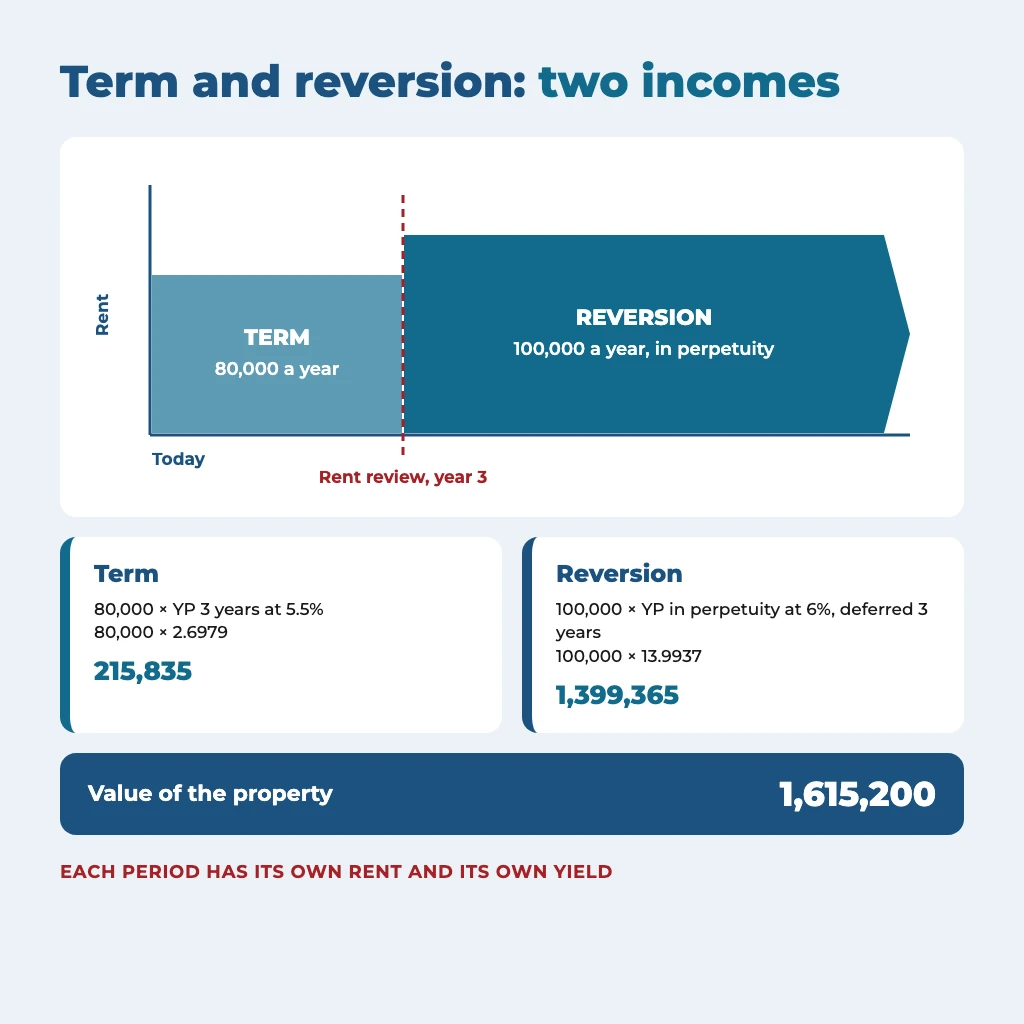
The passing rent is capitalised for three years at 5.5%. The years' purchase for 3 years at 5.5% is 2.6979.
80,000 × 2.6979 = 215,835
Step 2: value the reversion
From year 3 the building is assumed to produce the market rent in perpetuity. The years' purchase in perpetuity at 6% is 16.6667. That value arises in three years, so it is deferred with the present value of 1 in 3 years at 6%, which is 0.8396.
16.6667 × 0.8396 = 13.9937
100,000 × 13.9937 = 1,399,365
Step 3: add the two parts
215,835 + 1,399,365 = 1,615,200
The reversion accounts for 87% of the total. That proportion is typical where the term is short, and it shows where the valuation is sensitive: the market rent and the reversion yield matter far more than the yield on the term.
The income is cut vertically, at the date of the rent review. Each period has its own rent and its own yield.
Why the two yields differ
In the traditional form of the method, the yield on the term is lower than the yield on the reversion. The reasoning is about risk. A tenant paying less than the market rent has every reason to keep paying it, so the term income is regarded as more secure than a rent at the full market level. The reversion yield is taken from sales of comparable buildings let at the market rent, and the term yield is set a little below it.
That adjustment is the weak point of the method. The gap between the two yields is a matter of judgement, and it is rarely observed directly in the market. A term yield chosen by habit, half a point below the reversion yield in every report, is difficult to defend when a reviewer asks where it came from.
There is a second point to keep in mind. The reversion is valued at today's market rent, not at the rent expected in three years. Any growth in rent is implied in the yields and is not shown in the calculation. This is true of every conventional capitalisation, and it is the main reason why some assignments call for an explicit cash flow.
Initial, reversionary and equivalent yield
Three yields describe the result of the valuation. They are often quoted together, and they should not be confused with the yields used as inputs.
Initial yield: the passing rent divided by the value. Here, 80,000 ÷ 1,615,200 = 4.95%.
Reversionary yield: the market rent divided by the value. Here, 100,000 ÷ 1,615,200 = 6.19%.
Equivalent yield: the single yield which, applied to both the term and the reversion, gives the same value. Here it is about 5.99%.
The equivalent yield is the most useful of the three for comparison. It can be analysed from sales of other reversionary buildings and applied directly, which removes the need to choose two separate yields. Many valuers now work this way: they capitalise the term and the reversion at one equivalent yield drawn from the evidence, and state it in the report.
Term and reversion vs the layer method
The layer method, also called the hardcore method, values the same income by cutting it horizontally and not vertically.
The bottom layer, or hardcore, is the passing rent, treated as continuing in perpetuity.
The top layer is the increase expected at the review, the difference between the market rent and the passing rent, capitalised in perpetuity and deferred until the review.
In the example, the bottom layer is 80,000 a year in perpetuity and the top layer is 20,000 a year in perpetuity, deferred three years. If both layers are capitalised at the equivalent yield (5.993% before rounding), the result is 1,615,200, the same as before. The two methods are two ways of setting out the same cash flow. They give different answers only when different yields are applied to the parts.
The choice between them is partly a matter of convention in each market, and partly of what the valuer wants to show. Term and reversion follows the lease: it shows what happens at each date. The layer method follows the risk: it separates the income that is already secured from the income that depends on a future event.
When the property is over-rented
The opposite case arises when the passing rent is above the market rent. The property is over-rented, and the part of the rent above the market level, sometimes called the froth or the overage, will last only as long as the lease and the tenant do.
Here the layer method is the usual choice. The market rent is capitalised in perpetuity at a market yield. The excess is capitalised separately, only for the period during which it is contractually payable, and at a higher yield that reflects the risk that the tenant fails or negotiates. Take a building let at 120,000 a year with four years to the lease expiry, where the market rent is 100,000:
Core income: 100,000 in perpetuity at 6% = 1,666,667
Excess: 20,000 for 4 years at 8% (YP 3.3121) = 66,243
Value: about 1,732,900
Capitalising the full 120,000 in perpetuity at 6% would give 2,000,000 and overstate the value by more than 260,000. Treating a temporary rent as a permanent one is the most expensive mistake in this kind of valuation. The related question of how to analyse a rent that includes incentives is covered in our guide to headline rent and effective rent.
Term and reversion or discounted cash flow?
Term and reversion is a conventional method: growth and risk are implied in the yields. It is quick, it rests on yields that can be analysed from comparable sales, and it is well understood by the readers of valuation reports. For a building with one lease, one review and a modest gap between the two rents, it is entirely appropriate.
Its limits appear as the income becomes more complicated: several tenants with different review dates, break options, rent-free periods, voids and capital expenditure, or a long period before the reversion. Each of those needs an assumption that a single yield cannot show. A discounted cash flow sets out the income period by period and states the growth and the discount rate explicitly. Our guide to discounted cash flow in property valuation covers that method and when to prefer it.
The two are not rivals. Many valuers use the conventional method for the valuation and an explicit cash flow as a check, or the other way round, and explain any difference between the two.
The lease sets the dates and the rents. The market evidence sets the yields.
Six mistakes to avoid
Taking the wrong date for the reversion. The term runs to the next event at which the rent can change: a review, a break or the lease expiry. Read the lease before counting the years.
Forgetting to defer the reversion. Capitalising the market rent in perpetuity without deferring it values an income the owner does not yet receive.
Choosing the term yield by habit. A fixed margin below the reversion yield needs a reason. An equivalent yield taken from the evidence is easier to support.
Mixing the bases of comparison. A yield analysed from a building let at the market rent cannot be applied unchanged to a reversionary one, and the reverse is also true.
Assuming an upward movement that the lease does not allow, or a downward one that it prevents. Whether the rent can fall at review depends on the review clause.
Reporting the result without the inputs. A figure with no stated rents, dates and yields cannot be reviewed.
What to state in the report
Under the RICS Red Book, the report must set out the valuation approach and the reasoning, including the method used, the key inputs and the principal reasons for the conclusion (VPS 6). For a term and reversion valuation, the reader should be able to find:
the passing rent, and the date and nature of the next event under the lease;
the market rent adopted and the evidence for it;
the yield or yields applied, and the comparable sales from which they were analysed;
the resulting initial, reversionary and equivalent yields, so that the reader can compare the valuation with the market.
A term and reversion valuation is short, and every figure in it depends on something outside the calculation: the lease for the dates and the passing rent, the comparable evidence for the market rent and the yields. When those sources are kept in separate files, the calculation is easy to redo and hard to trace.
InterVal keeps them in one project. The lease review is recorded with the inspection, your own sales and lease data are stored in the comparable database, and the income approach is applied by income capitalisation with built-in calculators. The valuation report is then generated from that record. The valuer chooses the method, the rents and the yields, and remains responsible for them. To see it on your own use cases, book a 45-minute demo, or contact us.
This guide is provided for general information and reflects the standards in force at the date of publication. The examples are simplified and the figures are invented; they are not a substitute for professional judgement on a particular property. Always refer to the current edition of the International Valuation Standards and RICS Valuation – Global Standards, and to guidance applicable in your jurisdiction.
Frequently asked questions
What is the term and reversion method of valuation?
It is an income capitalisation in two parts. The term is the period during which the rent is fixed by the lease, and the passing rent is capitalised for that period. The reversion is everything after the next rent review or lease expiry: the market rent is capitalised in perpetuity and deferred for the length of the term. The two values are added.
How do you calculate a term and reversion valuation?
Multiply the passing rent by the years' purchase for the term, then multiply the market rent by the years' purchase in perpetuity deferred for the term, and add the two. With a passing rent of 80,000 for 3 years at 5.5% and a market rent of 100,000 at 6%, the term is worth 215,835, the reversion 1,399,365 and the property about 1,615,200.
What is the difference between term and reversion and the layer method?
Term and reversion cuts the income vertically, at the date of the rent review, and values each period. The layer or hardcore method cuts it horizontally: the passing rent is treated as continuing in perpetuity, and the increase expected at review is valued separately and deferred. At the same yield the two give the same result.
What is an equivalent yield?
The equivalent yield is the single yield which, applied to both the term and the reversion, gives the value of the property. It lies between the initial yield, which is the passing rent divided by the value, and the reversionary yield, which is the market rent divided by the value. In the worked example the initial yield is 4.95%, the reversionary yield 6.19% and the equivalent yield about 5.99%.
How do you value an over-rented property?
The usual choice is the layer method. The market rent is capitalised in perpetuity at a market yield. The part of the rent above the market level is capitalised separately, only for the period during which it is contractually payable, and at a higher yield that reflects its risk.
The rent written in a lease and the rent a landlord really receives are two different figures once a rent-free period or another incentive is involved. What headline rent and effective rent mean, two ways to calculate one from the other, and what the difference means for comparable evidence and for the valuation of a let building.
A fair price between two named parties, the extra value released by a combination, and the figure a property fetches when the seller is short of time. Two are bases of value defined in the International Valuation Standards and one is not a basis at all. What each means, how it differs from market value, two plots valued four ways, and how to report it.
Subscribe to our Newsletter
Subscribe to our newsletter to receive exclusive offers, latest news and updates.
Less than one hour to obtain a fully standard Compliant Valuation.