Headline Rent vs Effective Rent: What Valuers Need to Know
·10 min read
In short
Headline rent is the rent stated in a lease, payable once any rent-free period or other concession has ended. Effective rent, or net effective rent, is the headline rent adjusted for the value of the incentives the landlord gave to secure the letting, such as a rent-free period or a capital contribution. It is the rent the parties would have agreed with no incentive.
A lease states a rent of 100,000 a year. The tenant pays nothing for the first twelve months. What is the rent of that building? The lease says 100,000. The landlord's bank statement says less. A valuer who uses the letting as a comparable has to decide which figure to rely on, and the two can differ by a fifth or more.
The figure in the lease is the headline rent. The figure that reflects what the landlord really receives is the effective rent. This guide explains the difference, shows two ways to calculate one from the other, and sets out what it means for comparable evidence and for the valuation of a let building.
Headline rent vs effective rent: the short answer
Headline rent is the rent stated in the lease, payable once any rent-free period or other concession has ended. Some markets call it the face rent.
Effective rent, or net effective rent, is the headline rent adjusted for the value of the incentives the landlord gave to secure the letting. It is the rent the parties would have agreed with no incentive.
The gap between the two is the price of the incentive, spread over a number of years. When incentives are small, the two rents are close. In a weak letting market, landlords prefer to give long rent-free periods and keep the headline rent high, and the gap widens.
Four rents that are easily confused
Headline rent: the rent written in the lease.
Effective rent: the headline rent after allowing for incentives.
Passing rent: the rent the tenant is paying today. During a rent-free period it is nil.
Market rent: a basis of value defined in the International Valuation Standards. It is the estimated amount for which an interest in real property should be leased on the valuation date between a willing lessor and a willing lessee, on appropriate lease terms, in an arm's-length transaction, after proper marketing, where the parties had each acted knowledgeably, prudently and without compulsion.
The words "on appropriate lease terms" matter here. A market rent is always the rent for a given set of terms, and the incentives are part of those terms. A market rent of 100,000 with twelve months rent-free and a market rent of 85,000 with none can describe the same market. A report that gives a market rent should therefore say which terms it assumes. Our guide to the bases of value covers market rent alongside the other bases.
Why landlords give incentives
A landlord can attract a tenant by lowering the rent or by keeping the rent and giving something else. Most prefer the second. The headline rent appears in the lease, it is the figure quoted in the market, and it is the income a buyer will see when the building is sold. A rent-free period costs the landlord money once and then disappears from view.
The usual incentives are:
a rent-free period at the start of the lease, or a period at half rent;
a capital contribution to the tenant's fitting-out works;
a stepped rent that starts low and rises to the headline level;
taking over the tenant's existing lease in another building;
a cap on the service charge, or other concessions with a cost to the landlord.
Not all rent-free time is an incentive. A tenant taking empty space needs some weeks or months to fit it out before it can trade, and a short rent-free period for that purpose is normal in many markets. Valuers usually treat that fitting-out period as part of ordinary lease terms and count only the time beyond it as an incentive. The length that is normal depends on the market and the type of property, and it should be supported by evidence.
How to calculate the effective rent
Take a new lease of an office floor. The figures are invented for the illustration.
Headline rent: 100,000 a year
Lease term: 10 years, with a rent review at the end of year 5
Rent-free period: 12 months
Method 1: straight line
The simplest method adds up the rent the landlord will receive over a period and divides it by the length of that period. Over the five years to the review, the landlord receives four years of rent.
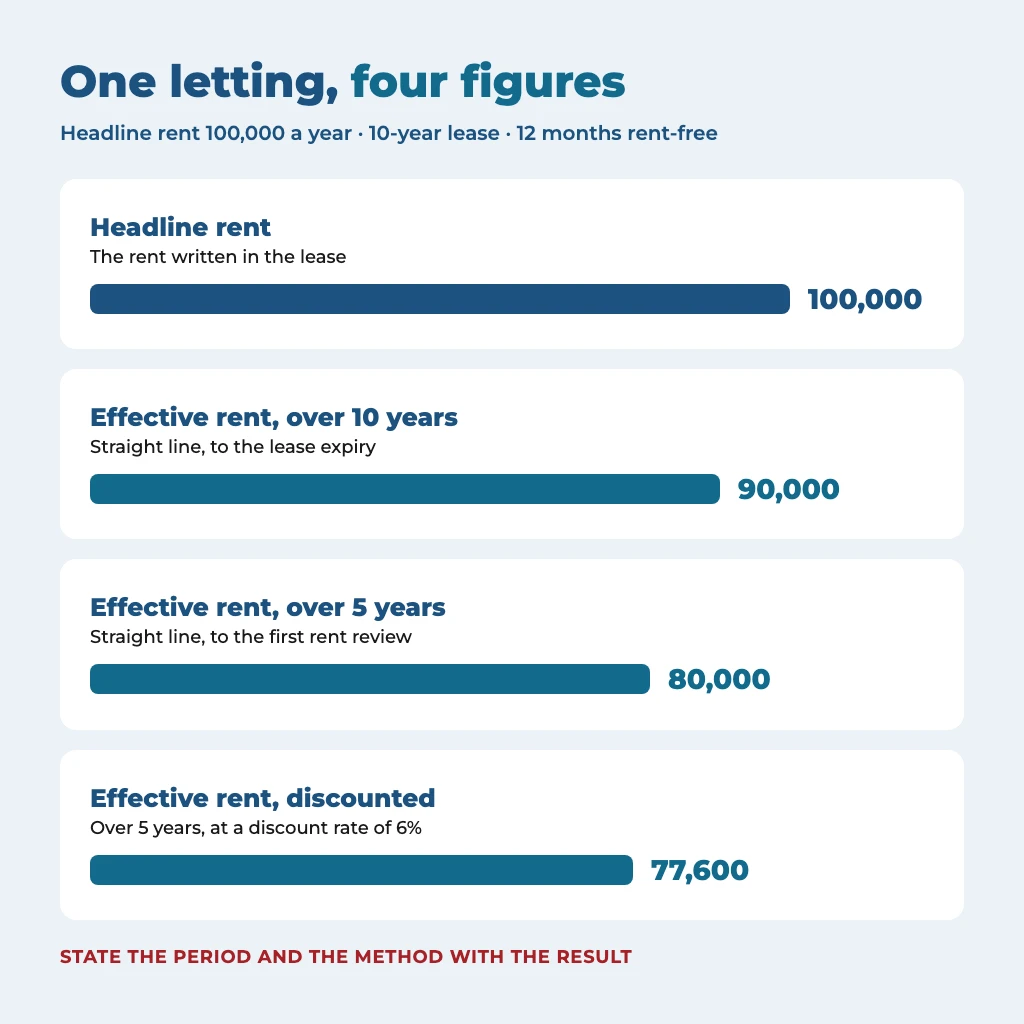
(100,000 × 4) ÷ 5 = 80,000 a year
If three of the twelve months are regarded as a normal fitting-out period, only nine months are an incentive, and the rent received is spread over four years and nine months.
(100,000 × 4) ÷ 4.75 = about 84,200 a year
Method 2: time value of money
The straight-line method treats rent received in year 5 as equal to rent given up in year 1. A discounted method corrects that. It finds the level rent, payable from the first day, that has the same present value as the rents the landlord will really receive.
At a discount rate of 6%, with rent taken annually at the end of each year, the four payments of 100,000 received in years 2 to 5 have a present value of about 326,900. A level rent paid for all five years would need to be about 77,600 to have the same present value.
326,900 ÷ 4.2124 = about 77,600 a year
The discounted figure is lower than the straight-line figure because the rent given up comes first. The choice of discount rate needs a reason, as any input does.
Over what period?
The period over which the incentive is spread changes the answer more than the choice of method. Over the full ten years, the straight-line effective rent is 90,000, and not 80,000.
(100,000 × 9) ÷ 10 = 90,000 a year
There is no single rule, and the right period depends on how long the tenant is committed to the headline rent:
to the first rent review, where the rent will then be reset to the market level and the incentive has bought only those first years;
to the first break option, where the tenant can leave at that date;
to the lease expiry, where there is no review to the market rent, or where the review can only raise the rent, so that the headline rent is expected to continue for the whole lease.
Because the answer moves so much, the period adopted is a matter of judgement and should be stated. Two valuers who analyse the same letting over different periods will report different effective rents, and both need to say what they did.
One letting, four figures. The period and the method must be stated with the result.
Other incentives
The same reasoning applies to the other incentives. A capital contribution of 50,000 towards the tenant's works, spread in a straight line over five years, reduces the effective rent by 10,000 a year. A stepped rent is analysed by adding up the rents payable over the period, or by discounting them. Where a letting carries several incentives, each one is converted to an annual amount on the same period, and the total is deducted from the headline rent.
What it means for comparable evidence
A market rent is derived from lettings of comparable property. If the headline rents of those lettings are used without adjustment, the result is a headline figure, and it will overstate the rental level whenever incentives were given.
Three practical rules follow.
Find out the incentives. A letting reported at a rent with no information on the rent-free period, the contribution or the lease length is weak evidence. Record what is known and what is not.
Analyse every comparable the same way. Use the same method, the same treatment of the fitting-out period and a consistent rule for the period. An effective rent on five years cannot be compared with one on ten.
Value on the basis you analysed. If the evidence was analysed to effective rents, the market rent adopted is an effective rent, and the valuation must not then add a rent-free period on top without adjusting the rent. If it was analysed on headline rents with typical incentives, the valuation must allow for those incentives.
Either convention can be correct. The error is to analyse on one and value on the other.
What it means for the valuation of a let building
The distinction affects an investment valuation in three ways.
During a rent-free period, the passing rent is nil. The building is valued on the rent that will become payable, and the rent-free time still to run is deducted, either by deferring the income or by deducting the outstanding rent-free amount from the value. Some sale contracts provide for the seller to top up the rent for that period, and the valuer should ask.
A passing rent above the market rent, with both expressed on the same terms, makes the building over-rented. This is the case where a headline rent was secured by incentives larger than the market now gives. The excess is secured only for as long as the lease runs and the tenant pays. Capitalising the whole headline rent in perpetuity overstates the value. The usual treatment values the market level in perpetuity and the excess separately, for a limited period and at a higher yield, as shown in our guide to term and reversion valuation.
The rent review clause decides what happens next. At review, the rent is set according to the assumptions and disregards written in the clause. Some clauses direct that any rent-free period be disregarded, which can produce a reviewed rent at a headline level. Others do not. The wording of the lease, and not the general practice of the market, governs the result.
Accounting standards have their own rules for spreading lease incentives in the accounts of the landlord and the tenant. Those rules govern the financial statements. They are not a method of valuation, and the figure in the accounts should not be taken as the effective rent without checking how it was calculated.
An empty floor needs fitting out before the tenant can use it. A short rent-free period for that purpose is not usually counted as an incentive.
Five mistakes to avoid
Using headline rents as market rents without adjustment. The comparable evidence then overstates the rental level.
Counting the incentive twice. Adopting an effective market rent and then deducting a full rent-free period as well understates the value.
Spreading every incentive over the whole lease by default. Where the rent is reset at a review or the tenant can break, a shorter period applies.
Ignoring the fitting-out period. Treating all rent-free time as an incentive understates the effective rent.
Reporting a market rent without its terms. A rent means little without the lease length, the review pattern and the incentives it assumes.
What to state in the report
Under the RICS Red Book, the report must set out the valuation approach and the reasoning, with the key inputs (VPS 6). Where rents and incentives are material to the value, the reader should be able to find:
for each comparable letting, the headline rent, the lease terms and the incentives, so far as they are known;
the method used to analyse them, the period adopted and any allowance for fitting out;
the market rent adopted and the lease terms it assumes;
for the property valued, the passing rent, any rent-free period still to run and how it was treated.
Most disagreements about rent come down to the record. A letting was noted at its headline rent, the rent-free period was mentioned on the telephone and never written down, and two years later nobody can say what the comparable really showed.
InterVal keeps the evidence with the assignment. Your own sales and lease data are stored in the comparable database, where the evidence is compared and adjusted, the lease review is recorded with the inspection, and the valuation report is generated from that record. The valuer analyses the lettings, chooses the method and remains responsible for the result. To see it on your own use cases, book a 45-minute demo, or contact us.
This guide is provided for general information and reflects the standards in force at the date of publication. The examples are simplified and the figures are invented; practice on incentives varies between markets. Always refer to the current edition of the International Valuation Standards and RICS Valuation – Global Standards, to the terms of the lease, and to guidance applicable in your jurisdiction.
Frequently asked questions
What is headline rent?
Headline rent is the rent stated in the lease, payable once any rent-free period or other concession has ended. Some markets call it the face rent. It takes no account of the incentives the landlord gave to secure the letting.
What is the difference between headline rent and effective rent?
Headline rent is the figure written in the lease. Effective rent, or net effective rent, is the headline rent adjusted for the value of incentives such as a rent-free period, a capital contribution or a stepped rent. The gap between the two is the price of the incentive spread over a number of years.
How do you calculate net effective rent?
The straight-line method adds up the rent receivable over a period and divides it by the length of that period. A headline rent of 100,000 with 12 months rent-free gives 80,000 a year over the five years to the first rent review. A discounted method finds the level rent with the same present value: about 77,600 a year at a discount rate of 6%.
Over what period should a rent-free period be spread?
There is no single rule. It depends on how long the tenant is committed to the headline rent: to the first rent review where the rent will be reset to the market level, to the first break option where the tenant can leave, or to the lease expiry where the headline rent is expected to continue for the whole lease. The period adopted is a matter of judgement and should be stated.
Is passing rent the same as headline rent?
No. Passing rent is the rent the tenant is paying today, and headline rent is the rent written in the lease. During a rent-free period the passing rent is nil while the headline rent is the full figure.
Market value, investment value and fair value sound interchangeable and sometimes give the same figure. They are three different questions, and one of them comes from accounting standards, not valuation standards. What each one measures, when to use it, one building valued three ways, and the neighbouring terms that add to the confusion.
When the rent a tenant pays is below the market rent, the valuer has two incomes to value, one after the other. How the term and reversion method works, one example taken through the calculation step by step, the initial, reversionary and equivalent yields it produces, and how it compares with the layer method and discounted cash flow.
Subscribe to our Newsletter
Subscribe to our newsletter to receive exclusive offers, latest news and updates.
Less than one hour to obtain a fully standard Compliant Valuation.