How to Choose Property Valuation Software: A Practical Buyer's Guide
RSRichard Sawyer, Co-founder, InterVal··6 min read
In short
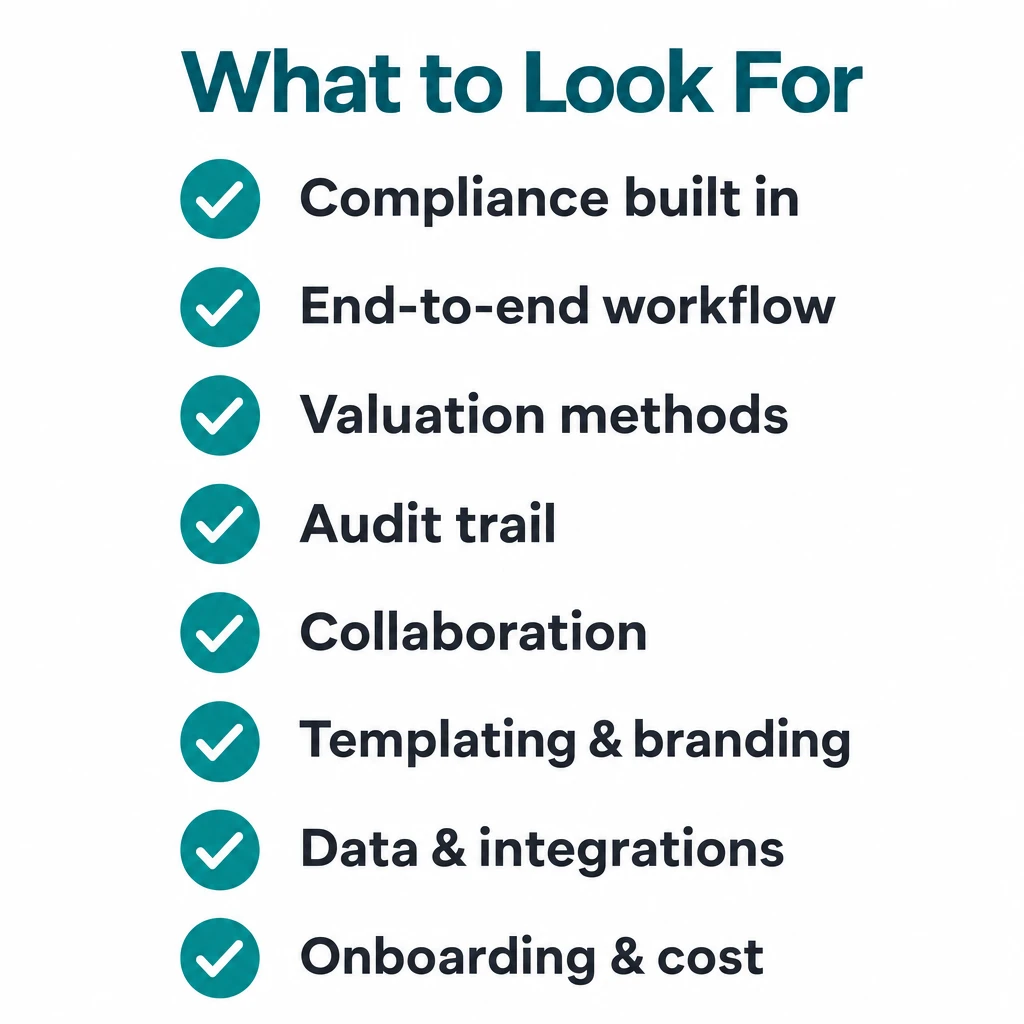
When choosing property valuation software, weigh eight criteria: compliance built into the workflow, end-to-end handling of the assignment, the valuation methods you actually use, a real audit trail, collaboration, templating, data and integrations, and onboarding and total cost. The best tool is the one that fits how you work — not the one with the longest feature list.
Choosing property valuation software looks like a procurement decision. It is really a professional one. The platform you pick shapes how you evidence compliance, how fast you turn work around, how a team collaborates, and how well a file stands up years later when someone challenges it. Get it right and the software quietly does the heavy lifting for years. Get it wrong and you are fighting your tools on every assignment.
Most "buyer's guides" for valuation software are written by vendors and read like a list of their own features. I run a valuation platform, so I could easily do the same — but a guide that only sells you my product is useless to you. So here is an honest framework instead: the criteria a valuer should actually weigh, including the cases where off-the-shelf software is not the right answer at all.
First, be honest about what you need
Before comparing products, be clear about your own situation, because it changes everything:
Sole practitioner, low volume. If you produce a handful of valuations a year, work alone, and rarely face an audit, a disciplined Word template and a good spreadsheet may genuinely be enough. Software earns its keep at volume and in teams.
Growing practice or team. The moment two people touch the same assignment, or you are producing valuations regularly for lenders and clients, the coordination and compliance overhead is where software pays for itself.
Enterprise / complex portfolios. Large institutional portfolios with heavy financial modelling may need specialist tools alongside, or instead of, a general valuation platform.
Matching the tool to your reality is the first decision. Everything below assumes you have crossed the threshold where structured software makes sense.
The criteria that actually matter
A practitioner's checklist for choosing property valuation software.
1. Compliance built into the workflow — not bolted on
The most important question is not "can it produce a report?" but "does the process itself keep me compliant?" Good valuation software follows the structure of the RICS Red Book and IVS: it prompts for terms of engagement, captures the basis of value, records the inspection, and assembles the required content — so compliance is a property of how you work, not a checklist you run at the end. If a tool just formats a document and leaves the standards entirely to you, it is a word processor with a nicer template. (Our guide to Red Book compliance sets out what that framework actually requires.)
2. The full assignment, end to end
Valuation is a workflow, not a single document: engagement, conflict checks, inspection, method selection, the report, and the audit trail. The strongest platforms handle the whole assignment in one place. Beware suites stitched together from separate tools that don't talk to each other — the gaps between them are exactly where errors and non-compliance creep in. (We covered that failure mode in valuation software vs. spreadsheets.)
3. The valuation methods you actually use
Check that the software supports the approaches and methods your work demands — market comparison, income capitalisation, depreciated replacement cost, discounted cash flow — and that the calculations are reliable and reviewable rather than a black box. If you do a lot of income work, look closely at how it handles DCF; if you value specialised assets, check for DRC. A tool that only supports one method will quietly limit the work you can take on.
4. A real audit trail
Compliance is evidenced, not asserted. The platform should record the reasoning, the evidence, the assumptions and the sequence of an assignment — automatically, as you work — so that months or years later the file can show what was done and why. Ask any vendor a simple question: "when a valuation is challenged, what does your audit trail show?" The answer tells you a lot.
5. Collaboration and review
If more than one person touches an assignment, the software must let a team work on the same file in real time, with the senior valuer able to review what changed. Emailing files back and forth is not collaboration — it is version chaos waiting to happen.
6. Templating, customisation and branding
Your reports carry your firm's identity and your clients' expectations. Look for a templating system that lets you standardise across jobs while adapting logos, layouts and content to each client — consistency and flexibility at once, not one at the expense of the other.
7. Data and integrations
Consider how the tool handles comparable evidence and your own databases, and whether it fits your wider systems. Not every practice needs deep integrations on day one, but it is worth knowing whether the platform can grow with you or will become an island.
8. Onboarding, support and total cost
The sticker price is rarely the real cost. What matters is time-to-value: how quickly you can be productive, what onboarding and training are included, and how responsive support is when you are mid-assignment with a deadline. An off-the-shelf platform you can configure in an afternoon beats a "powerful" system that takes months to implement.
When software is not the answer
An honest guide has to say this. Valuation software is not a universal fix.
If your volume is genuinely low and you work alone, the cost and change may not be justified — a rigorous manual process can serve you well.
If your work is dominated by complex institutional financial modelling, you may need specialist modelling tools that a general valuation platform is not designed to replace.
And no software removes the valuer's judgement, ethics or accountability. A platform makes the process reliable; it does not make the valuation for you, and you should be wary of any vendor implying otherwise.
The right question is not "which tool has the most features" but "which tool fits how I actually work, and takes the mechanical load off so I can focus on judgement."
The best tool is the one that fits how you work — not the one with the longest feature list.
A quick red-flag list
Signs to be cautious of when evaluating any property valuation software:
It formats reports but leaves standards compliance entirely to you.
There is no real audit trail — you cannot reconstruct how a value was reached.
It supports only one valuation method.
Collaboration means emailing files around.
Implementation is measured in months, not hours.
The demo shows the happy path but dodges your compliance questions.
How InterVal measures up
To be transparent about where I sit: InterVal was built precisely around the criteria above. It is an all-in-one, off-the-shelf platform that guides an assignment from engagement to report with the RICS Red Book and IVS structure built in, market and income-capitalisation methods today (DRC and DCF with the Professional plan), real-time collaboration, a templating system, and an audit trail that builds itself as you work — configurable in 20–30 minutes rather than months. You can see the output in our sample reports and the plans on our pricing page.
But the honest advice stands whichever tool you choose: weigh it against the criteria that fit your practice, ask the hard compliance questions in the demo, and pick the platform that lets you spend less time fighting your software and more time being a valuer.
This guide is a practitioner's perspective for general information. References to RICS and IVS reflect the standards in force at the time of writing; always refer to the current editions and to guidance applicable in your jurisdiction.
Frequently asked questions
What should I look for when choosing property valuation software?
Prioritise eight criteria: compliance built into the workflow (not bolted on), handling of the whole assignment end to end, support for the valuation methods you actually use, a real audit trail, collaboration and review, templating and branding, data and integrations, and onboarding and total cost. Feature count matters far less than fit with how you work.
Do I really need valuation software, or is a spreadsheet enough?
If you produce a handful of valuations a year, work alone and rarely face an audit, a disciplined Word template and spreadsheet can be enough. Software earns its keep at volume, in teams, and where reports go to lenders or courts. We compare the two in valuation software vs. spreadsheets.
How long should it take to implement valuation software?
The best off-the-shelf platforms are configurable in hours, not months — InterVal is typically set up in 20–30 minutes. Treat an implementation measured in months as a red flag: the sticker price is rarely the real cost, time-to-value is.
What are the red flags when evaluating valuation software?
Be cautious if a tool formats reports but leaves standards compliance entirely to you, has no real audit trail, supports only one valuation method, treats collaboration as emailing files around, takes months to implement, or shows a polished demo that dodges your compliance questions.
Does valuation software make my valuations compliant automatically?
No. Good software makes the process reliable and keeps the required steps present by construction, but it does not remove the valuer's judgement, ethics or accountability. A platform makes the valuation defensible; it does not make the valuation for you.
An audit trail sounds like bureaucracy; it is the opposite — the record of how a valuation was reached, and the only thing that lets a reviewer, insurer or regulator rely on it years later. What a defensible audit trail contains, where the RICS Red Book and IVS require it, why files fail without one, and why it should be captured as you work rather than reconstructed from memory.
Valuation files are some of the most sensitive data a professional handles — so is the cloud safe for them? A practical framework from InterVal's technology lead: what real cloud security looks like (encryption, access control, audited hosting, data residency, backups, audit trail, data ownership), the questions to ask any vendor, and why the real risk is usually the laptop-and-email workflow, not the cloud.
Subscribe to our Newsletter
Subscribe to our newsletter to receive exclusive offers, latest news and updates.
Less than one hour to obtain a fully standard Compliant Valuation.