The Future of Property Valuation: Five Forces Reshaping the Profession
JBJoachim Bertot, Founder, InterVal··6 min read
In short
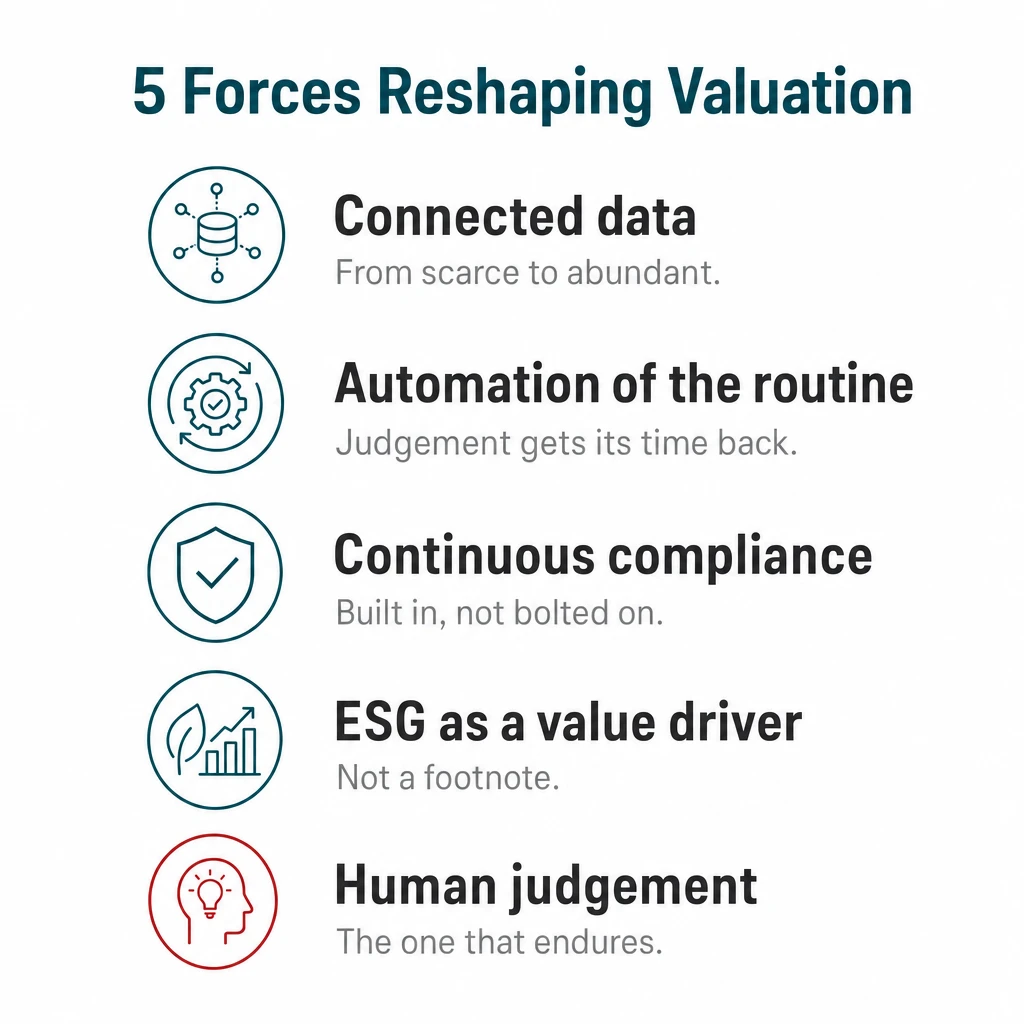
Property valuation is being reshaped by five forces: connected data becoming abundant, automation of the routine, compliance moving from a final checklist to a continuous property of the work, ESG becoming a value driver, and a widening gap between modernised and unmodernised firms. What does not change is the human at the centre — the judgement, ethics and accountability of a professional standing behind a number.
I came to property valuation from the outside, and from the worst possible angle. In 2018 my firm — then the only RICS-accredited valuation practice in Mongolia — was asked by the International Monetary Fund to review the valuations behind real estate held as collateral across the country's banks. Thousands of reports. The overwhelming majority failed to follow RICS, IVS, or any standard at all.
What struck me was not that the valuers were bad. Many were skilled, conscientious people. It was that they were doing careful work with broken tools, in a profession that technology had almost entirely passed by. That gap — between the quality of the people and the poverty of their tools — is the thing I have spent the years since trying to close. It is also, I think, the single best lens for understanding where this profession is heading.
Here is how I see the next decade in property valuation, and what it asks of the firms living through it.
The forces reshaping the profession
Five forces reshaping property valuation over the next decade — and the one that doesn't change.
1. Data stops being scarce — and quality becomes the new battleground
For most of this profession's history, the hard part of a valuation was getting the evidence: tracking down comparables, piecing together transaction data, reconstructing what a market actually did. That scarcity is ending. Connected data sources, richer records and better tooling mean the modern valuer will increasingly have more data than they can manually handle, not less.
That sounds like good news, and it is — but it moves the difficulty rather than removing it. When data is abundant, the skill shifts from finding evidence to governing it: knowing which data to trust, documenting where it came from, and being able to defend it. Governance, not gathering, becomes the constraint.
2. The routine gets automated — and judgement gets its time back
This is the change people fear most and understand least. The mechanical parts of a valuation — formatting a report, assembling the file, running the calculations, checking that the required documents are present — are exactly the parts software does best. Over the next decade, that work will increasingly be automated away.
I want to be very clear about what that does and does not mean, because the anxiety around it is misplaced. It does not mean the valuer is replaced. It means the valuer stops spending half of every assignment on clerical work and gets that time back for the thing only they can do: judgement. The profession's value was never in formatting a document or dragging a formula. It was in the expert reading a property and a market, and standing behind a number. Automation does not threaten that. It frees it.
3. Compliance moves from a final checklist to a continuous property of the work
The standards are not standing still, and 2025 was a watershed. Both the RICS Red Book and IVS were updated and brought into close alignment, effective 31 January 2025, with a restructured framework and a new standard holding valuers responsible for the integrity of the models they use. (I wrote about what that means in our practitioner guide to Red Book compliance.)
The direction of travel is unmistakable: compliance is becoming something that lives inside the process rather than something you assemble at the end. The future valuation file is not "the work, then a compliance check." It is work that is compliant by construction, with the audit trail building itself as the valuer goes. Firms still treating compliance as a final scramble are running a model the standards are quietly leaving behind.
4. ESG becomes a value driver, not a footnote
Sustainability has crossed a line that I do not think enough of the profession has fully registered. As of 30 April 2026, RICS's dedicated ESG standard is mandatory, and ESG is now embedded in both the Red Book and IVS. (More on that in our piece on ESG in property valuation.)
But the regulation is only catching up to the market. Energy performance, climate risk and a building's sustainability profile increasingly move rents, yields and lettability in the real world. Over the next decade the green premium and the brown discount stop being specialist concerns and become part of the basic arithmetic of value. The valuer who cannot speak to a building's ESG profile will simply be valuing a different, less accurate building than the market is pricing.
5. The gap between modernised and unmodernised firms widens — fast
Put the first four together and you get a fifth, and it is the one that will decide who thrives. The firm that has structured its data, automated its routine, embedded its compliance and built ESG into its workflow operates at a completely different speed and quality from the firm still living in Word and Excel. (We laid out that contrast in valuation software vs. spreadsheets.)
For most of the last twenty years a practice could ignore technology and be fine. That window is closing. The pressures above are not optional extras a firm can adopt at leisure; they are becoming the cost of doing the job credibly. The gap between the two kinds of firm is going to widen faster than most people expect.
The valuer of the next decade spends less time on the mechanical and more on the judgement only they can provide.
What does not change
I have spent this whole piece on what is shifting, so let me be just as clear about what is not. None of this removes the human being from the centre of a valuation. The judgement of how a property reads, the ethics of an independent opinion, the accountability of a name on a report — these are not problems technology solves, and they are not problems anyone should want it to solve. A valuation is, in the end, a professional taking responsibility for a number. That is permanent.
This is why I have always been suspicious of the framing that pits technology against valuers. The right relationship is the opposite. Technology should carry the mechanical load so the professional can do more of the work that actually requires a professional. Empower, don't replace. Every product decision we make at InterVal comes back to that conviction.
Why I am optimistic
I started in this profession by reading thousands of valuations that had gone wrong, in a market with no tools to do better. It would have been easy to come away cynical. I came away with the opposite feeling, and I still hold it.
Because the failures I saw were almost never failures of people. They were failures of process and tooling — and process and tooling are exactly the things that can be fixed. The next decade hands this profession better data, better automation, clearer standards and tools that finally match the skill of the people using them. The valuers who lean into that will spend less time fighting their software and more time being valuers. That is a future worth building toward, and it is the one I am betting on.
This is a personal perspective. References to the RICS Red Book, IVS and the RICS ESG standard reflect the editions and effective dates in force at the time of writing; always refer to the current standards and to guidance applicable in your jurisdiction.
Frequently asked questions
Will technology replace property valuers?
No. Automation removes the mechanical work — formatting, assembling the file, running calculations — not the judgement. A valuation is, in the end, a professional taking responsibility for a number; the right relationship is technology carrying the mechanical load so the valuer does more of the work that actually requires a valuer.
What are the biggest trends shaping the future of property valuation?
Five forces: data becoming abundant (so governing it, not gathering it, becomes the skill); automation of routine tasks; compliance built into the workflow rather than checked at the end; ESG shifting from footnote to value driver; and a fast-widening gap between firms that have modernised and those still living in Word and Excel.
How is ESG changing property valuation?
The RICS ESG standard has been mandatory since 30 April 2026, but regulation is only catching up to the market. Energy performance, climate risk and sustainability increasingly move rents, yields and lettability — so the green premium and brown discount are becoming part of the basic arithmetic of value. More in our guide to ESG in property valuation.
What did the 2025 standards changes mean for valuers?
The RICS Red Book and IVS were updated and closely aligned, effective 31 January 2025, with a restructured framework and a new standard holding valuers responsible for the integrity of the models they use. The direction of travel is compliance that lives inside the process, with the audit trail building itself as the valuer works.
An audit trail sounds like bureaucracy; it is the opposite — the record of how a valuation was reached, and the only thing that lets a reviewer, insurer or regulator rely on it years later. What a defensible audit trail contains, where the RICS Red Book and IVS require it, why files fail without one, and why it should be captured as you work rather than reconstructed from memory.
Valuation files are some of the most sensitive data a professional handles — so is the cloud safe for them? A practical framework from InterVal's technology lead: what real cloud security looks like (encryption, access control, audited hosting, data residency, backups, audit trail, data ownership), the questions to ask any vendor, and why the real risk is usually the laptop-and-email workflow, not the cloud.
Subscribe to our Newsletter
Subscribe to our newsletter to receive exclusive offers, latest news and updates.
Less than one hour to obtain a fully standard Compliant Valuation.